





The Tyranny of the Rocket Fairing
One of the biggest challenges in space exploration isn't necessarily getting to another planet, but safely landing there. When a spacecraft enters an atmosphere, whether it's Earth's or Mars', it travels at hypersonic speeds, generating scorching temperatures
from air friction. For decades, the solution has been rigid heat shields, or aeroshells, that protect the craft. But these have a fundamental limitation: they must fit inside the rocket fairing (the nose cone) that launches them from Earth. This size constraint directly limits the size—and therefore the weight—of the payload they can protect. For ambitious goals like landing human habitats or heavy robotic explorers on Mars, engineers needed a bigger brake.
The Inflatable Solution
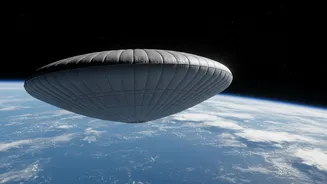
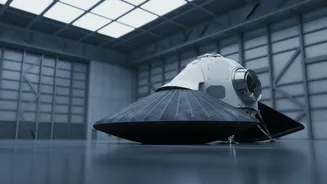
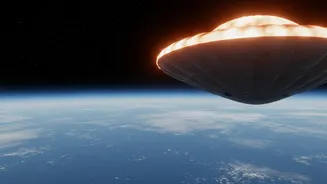
Enter the Hypersonic Inflatable Aerodynamic Decelerator, or HIAD. The concept is brilliantly simple in theory: a heat shield that can be packed into a small volume for launch and then inflated to a much larger diameter before entering a planet's atmosphere. This larger surface area creates significantly more drag, allowing the spacecraft to begin decelerating higher in the atmosphere where the air is thinner, resulting in a gentler braking process and lower peak heating. This technology, developed by NASA for over a decade, aims to overcome the launch fairing size limit, enabling missions to carry heavier payloads to destinations with an atmosphere, like Mars, Venus, or Saturn's moon Titan.
Built to Survive the Inferno
While it may sound like a balloon, a HIAD is an incredibly tough piece of engineering. The structure consists of a series of concentric rings, or tori, that are inflated with nitrogen. These rings are woven from synthetic polymers that are, by weight, ten times stronger than steel, providing a rigid shape once pressurized. The business end of the shield, the Flexible Thermal Protection System, is a multi-layered marvel. The outermost layer is a black fabric woven from silicon carbide ceramic fibres, capable of withstanding the extreme temperatures of re-entry. Beneath this are layers of advanced insulation that protect the inflatable structure itself, ensuring it maintains its shape and integrity throughout the fiery descent.
Proof of Concept: The LOFTID Mission
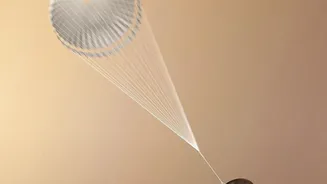
This technology is not just theoretical. In November 2022, NASA successfully demonstrated it with the Low-Earth Orbit Flight Test of an Inflatable Decelerator (LOFTID) mission. Launched as a secondary payload, the 6-meter (about 20-foot) diameter shield inflated in space and re-entered Earth's atmosphere at nearly 18,000 miles per hour. It survived peak deceleration forces and heating, splashing down gently in the Pacific Ocean under a parachute. The recovered vehicle was in excellent condition, proving the viability of the technology. NASA declared the test a "huge success," confirming that HIAD technology is ready to be incorporated into future missions.
Unlocking the Future of Exploration
The success of inflatable heat shields opens a new chapter for space missions. It is a key enabling technology for landing larger, heavier payloads on Mars, a critical step for eventual human exploration. This could include habitats, ascent vehicles for returning astronauts, and larger scientific laboratories. Beyond Mars, the technology could be used for missions to Venus and Titan, or for returning large assets—like reusable rocket stages or materials manufactured in space—safely back to Earth. Several commercial companies have already expressed interest in the technology, suggesting a broad range of future applications.