
The Raw Materials: What ISRO Found
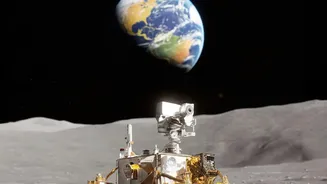
India's Chandrayaan missions have provided crucial data about the resources available at the lunar south pole. The Chandrayaan-3 rover, Pragyan, conducted the first-ever in-situ analysis of the elemental composition of the soil in this region. Its instruments
confirmed the presence of several key elements, including aluminium, iron, calcium, chromium, titanium, manganese, silicon, and oxygen. Most notably, it unambiguously confirmed sulphur, an element whose presence was difficult to verify from orbit. Complementing this, data from the Chandrayaan-2 orbiter's radar has provided strong evidence of subsurface water ice hidden in permanently shadowed craters. These craters are extremely cold, never see sunlight, and are considered ideal locations for preserving ice over geological timescales. Together, this soil (regolith) and water ice form the fundamental building blocks for a future lunar settlement.
Water: The Moon's Most Precious Resource
The confirmation of water ice is a game-changer for establishing a sustained human presence. Transporting materials from Earth is incredibly expensive, so living off the land, a concept known as In-Situ Resource Utilization (ISRU), is critical. Water is paramount. It can be harvested and purified for drinking and growing plants. More importantly, through a process called electrolysis, water (H₂O) can be split into its constituent parts: hydrogen and oxygen. Oxygen is not only essential for breathable air but is also a critical component of rocket propellant (an oxidizer). Hydrogen is a powerful rocket fuel itself. By producing their own air and fuel on the Moon, future astronauts can drastically reduce their reliance on Earth, making long-term missions more feasible and affordable.
Lunar Soil: More Than Just Dust
The lunar soil, or regolith, is another vital local resource. The analysis from Chandrayaan-3 showed it's rich in elements like silicon, aluminium, and iron, which have immense construction potential. This regolith can be used as a building material to construct habitats, landing pads, and roads. One promising technique is 3D printing, where regolith is heated or mixed with a binding agent to create bricks and structural components. These structures would provide essential protection from the Moon's harsh environment, including extreme temperature swings, micrometeoroid impacts, and dangerous cosmic radiation. Furthermore, ISRO's analysis found that the soil has a complex, layered structure, which is crucial information for designing foundations and infrastructure. The discovery of sulphur also opens possibilities for creating sulphur-based concrete, a useful construction material.
Powering a Lunar Outpost and The Road Ahead
Beyond air and shelter, a lunar base needs power. Extracting oxygen from the regolith, a process NASA is also developing, is energy-intensive but foundational. The elements found by Chandrayaan-3, like silicon, could theoretically be used to manufacture solar cells on-site, providing a renewable energy source. However, the path to a lunar habitat is fraught with immense challenges. The lunar dust is sharp and abrasive, capable of damaging spacesuits and equipment. The extreme temperatures and radiation require robust and resilient technologies. Mining resources in permanently shadowed craters, which are among the coldest places in the solar system, is an unprecedented engineering feat. While ISRO's findings provide the blueprint of what is possible, turning that possibility into a reality will require decades of technological innovation and international collaboration.