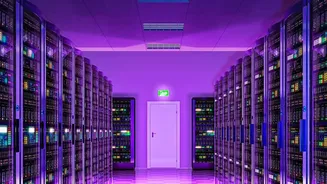








Our digital world, from streaming services to the cloud, runs on massive, power-hungry data centres. A landmark Harvard study now puts a number on their environmental cost, revealing a carbon footprint that is growing at an alarming rate.
The Soaring Energy Bill of the Digital Age
New research
from Harvard University has quantified the immense and rapidly expanding environmental footprint of the US's largest 'hyperscale' data centres. The study, published in Nature Sustainability, found that just 403 of these facilities produced approximately 25.7 million metric tons of carbon dioxide between May 2024 and April 2025. To put that into perspective, it's a carbon footprint roughly equivalent to the entire nation of Denmark. The researchers found that this was a two- to three-fold increase from estimates based on 2018 data, underscoring the explosive growth in just a few years. Worryingly, the study revealed that more than half (54%) of the electricity powering these digital factories came from burning fossil fuels, primarily natural gas and coal.
The AI Engine Guzzling Power
The primary driver behind this surge in energy consumption is the artificial intelligence boom. Training and operating large AI models requires an extraordinary amount of computational power, far exceeding traditional computing tasks. For instance, a single ChatGPT query can use nearly ten times more electricity than a standard Google search. The International Energy Agency (IEA) has projected that global electricity consumption by data centres could double by 2030, with AI being the main cause. The Harvard researchers noted their data was collected before the most recent acceleration in AI development, meaning the current energy use and carbon footprint are likely 'substantially larger' now in late 2026.
A Footprint Rivaling Entire States
The scale of this energy use is difficult to comprehend. The Harvard study estimated that the US hyperscale data centres they examined consumed between 68 and 99 terawatt-hours of electricity in a year. At the upper end, that's comparable to the annual electricity usage of entire US states like Michigan, Indiana, or Tennessee. This accounts for an estimated 1.8% of the total electricity consumption in the United States. The IEA warns that without a significant shift, natural gas is projected to supply about 60% of the electricity for US data centres by 2030. This intense concentration of energy demand is not only a climate issue but also puts significant strain on regional power grids.
The Search for Sustainable Solutions
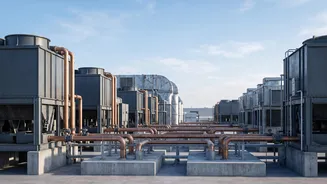
The report highlights that a data centre's carbon footprint heavily depends on its location and the local energy grid. A facility in Wyoming, which relies heavily on coal, produces significantly more carbon for the same amount of electricity than one in Oregon, which benefits from hydropower. This points toward the most critical solution: powering data centres with renewable energy. Beyond shifting to solar and wind, the industry is also exploring innovations in efficiency. These include advanced liquid cooling systems, which can be 30-40% more energy-efficient than traditional air cooling, designing more efficient server hardware, and using AI itself to predict and optimize power management within the facility. Other strategies involve building data centres that can participate in 'demand response' programs, reducing their power draw during peak grid times to improve overall stability.