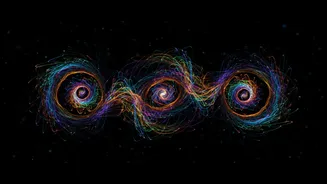








First, What Is a Skyrmion?
Before adding light to the equation, it helps to understand the basic concept. The idea of a skyrmion first emerged from particle physics in the 1960s. It describes a stable, knot-like disturbance within a continuous field. Imagine a perfectly combed
field of grass where all blades point up. A skyrmion would be a tiny, swirling vortex where the blades of grass twist in a stable, persistent pattern before returning to their upward direction at the edges. For decades, this concept was primarily applied to magnetic materials, where these 'whirlpools' are formed by the spin of electrons. Their stability and tiny size make these magnetic skyrmions promising candidates for ultra-dense data storage.
Adding Light to the Mix
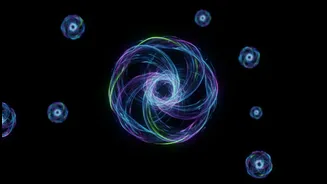
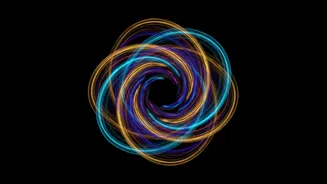
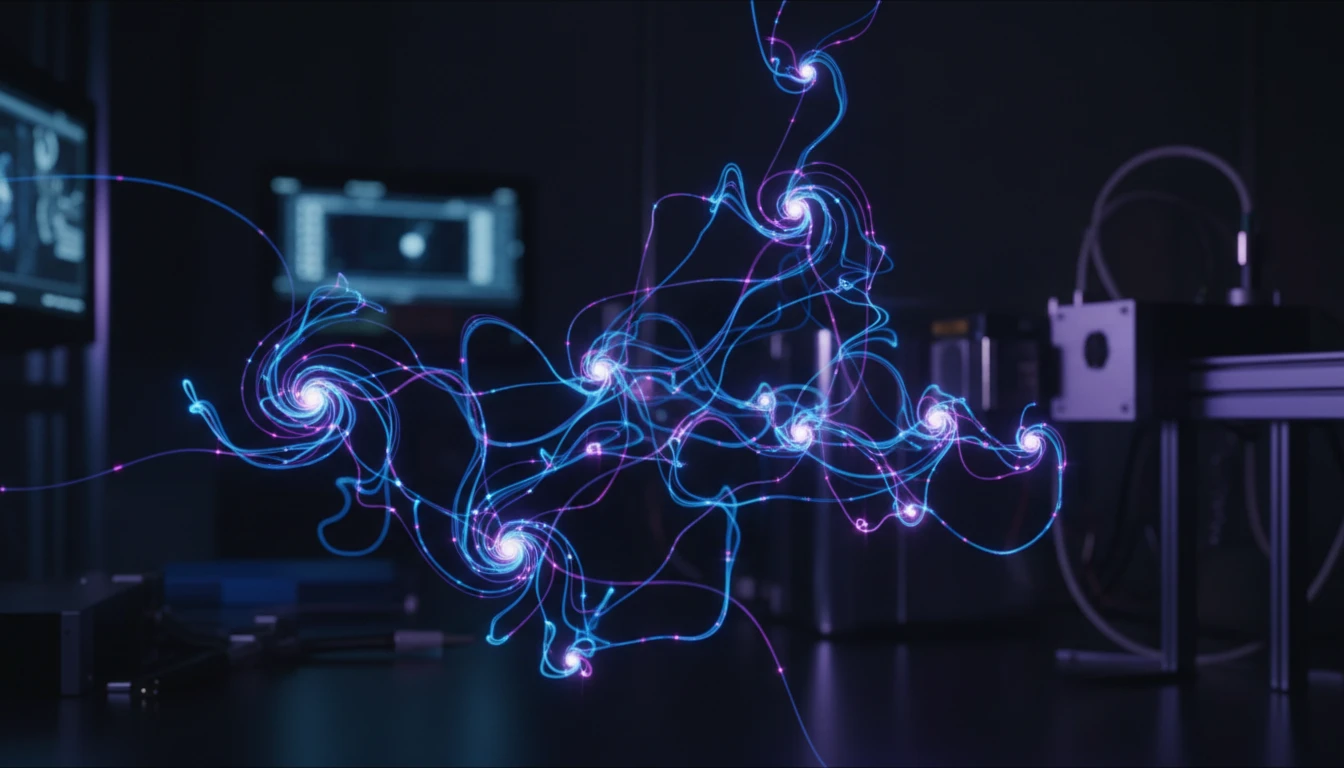
The real breakthrough for computing came when scientists figured out how to create these stable, particle-like knots using light instead of magnetism. An optical skyrmion is essentially a sculpted whorl in a light field, where properties like polarisation and phase are twisted into a robust topological pattern. Think of it as a tiny, self-contained knot of light that doesn't easily come undone. Initially, creating these required complex setups with special materials like metamaterials or plasmonic surfaces. However, very recent discoveries have shown it's possible to generate them with far simpler methods, such as shining a laser at a small disc—a modern twist on a 200-year-old physics experiment. This accessibility makes it easier for more researchers to explore their potential.
The Promise for Future Computing
The excitement around optical skyrmions stems from their potential to overcome the limitations of current electronics. Today's computers run on electrons, which generate heat and have speed limits. Photonics—using light (photons) instead of electrons—promises computation at the speed of light with much lower power consumption. Optical skyrmions could serve as robust carriers of information in these future photonic systems. Their discrete, stable nature makes them ideal for representing the 0s and 1s of digital data. Because they are so small and can be packed densely, they offer a path to data storage and processing capabilities far beyond what is possible today.
More Than Just Storage
The applications extend beyond just storing data. Optical skyrmions could be used for all-optical logic and computation, forming the building blocks of light-based processors. Furthermore, their unique structure allows them to overcome the traditional diffraction limit of light, enabling super-resolution imaging techniques that could see details far smaller than the wavelength of light used. In the quantum realm, their inherent stability makes them ideal candidates for qubits, the fundamental units of quantum computers. Entangled quantum skyrmions could lead to new forms of secure communication, transmitting information with unprecedented capacity and security.
The Road Ahead
Despite the immense promise, optical skyrmions are not yet ready for commercial prime time. Researchers are still working on fundamental challenges. Ensuring these light structures remain stable under various conditions, controlling them precisely, and integrating them into on-chip systems are significant engineering hurdles that must be overcome. While magnetic skyrmions are physical entities with strong energy barriers that make them stable, their optical counterparts are more fragile. The current work is focused on moving from fundamental discovery to applied engineering, figuring out how to transform this incredible scientific potential into practical technologies that can be manufactured at scale.