



A Famous Northern Enigma
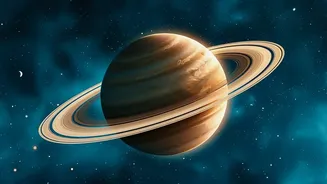
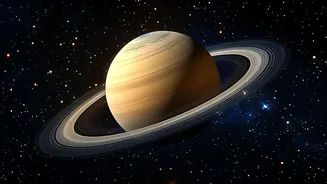
For over forty years, one of the most baffling features in our solar system has been Saturn's hexagon. First spotted by the Voyager spacecraft in the early 1980s, this massive, six-sided jet stream swirls around the planet's north pole. With sides longer
than the diameter of Earth, it's a weather pattern of colossal scale. Unlike the turbulent, ever-changing storms we see on Earth or even Jupiter, Saturn's hexagon is remarkably stable, maintaining its sharp geometric shape for decades. This persistence has made it a planetary icon, a feature so strange it seems almost artificial. Scientists have long theorised that the hexagon is a type of standing wave in the atmosphere, a jet stream moving at just the right speed to bend into a stable six-sided shape. For a long time, it was considered a one-of-a-kind spectacle.
A Surprise Unveiled in the South
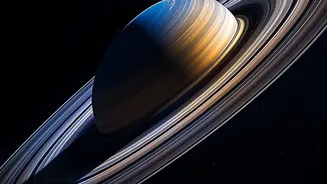
Just when scientists thought they had a handle on Saturn's polar oddities, the planet threw them a curveball. Or rather, a decagon. Thanks to Saturn's axial tilt, its southern pole was hidden from Earth-based view for over a decade. But as the seasons changed and the pole tilted back towards us, the Hubble Space Telescope got a clear look. In images captured since 2023, a new and unexpected pattern emerged: a massive, 10-sided polygon swirling around the south pole. The discovery, confirmed in a September 2026 study, was a complete surprise. Researchers had searched for a southern counterpart to the hexagon for years using data from the Cassini spacecraft, which orbited Saturn from 2004 to 2017, but found no trace of one. This new decagon seems to have formed only recently, giving scientists a rare ringside seat to the birth of a giant atmospheric phenomenon.
The Physics of Planetary Polygons
So, how does a planet's atmosphere create near-perfect geometric shapes? The leading explanation for both the hexagon and the new decagon involves the physics of jet streams on a rapidly rotating gas giant. On planets like Saturn, powerful wind currents, known as zonal jets, flow eastward. Scientists believe that if these jets are disturbed or perturbed, they can start to meander. Under specific conditions, this meandering can lock into a stable, repeating pattern—a standing wave. The number of 'sides' to the polygon depends on the precise properties of the jet stream and the surrounding atmosphere. While the underlying physics might be similar for both poles, the fact that one formed a hexagon and the other a decagon presents a fascinating puzzle. It suggests subtle differences in the atmospheric conditions between the northern and southern hemispheres dictate the final shape of these colossal waves.
A Dynamic and Evolving Mystery
Unlike its northern counterpart, the southern decagon is not a static feature. Observations show that it is still evolving and strengthening. Whereas the hexagon's sides have been relatively uniform for decades, the decagon's brightness and definition vary, suggesting it is a younger, more dynamic system. This offers an unprecedented opportunity for planetary scientists to study how such a structure forms in real-time. The discovery also highlights the valuable collaboration between professional and amateur astronomers. Early hints of the southern wave were first noticed in 2024 by amateur observers who contribute their images to online databases. These initial sightings prompted professional researchers to take a closer look with Hubble, ultimately confirming the decagon's existence. The central question now is whether the decagon will stabilize into a long-lasting feature like the hexagon or if it will change shape or dissipate in the coming years.
What These Shapes Tell Us
These polar polygons are more than just cosmic curiosities. They are giant natural laboratories for understanding how atmospheres behave on a massive scale without the influence of oceans or solid landmasses that dictate weather on Earth. Studying why Saturn produces stable polygons while its neighbour Jupiter features chaotic clusters of smaller vortices at its poles helps scientists refine their models of planetary interiors and energy transfer. The discovery that Saturn can create two different polygons implies that the conditions for their formation might be more common than previously thought. It proves that even after centuries of observation, the gas giants of our own solar system still hold profound secrets, challenging our understanding of the fundamental laws of physics that govern planets everywhere.