




A Mission Within a Mission
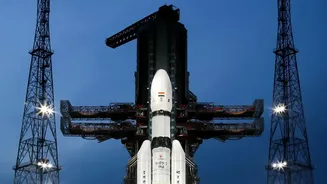
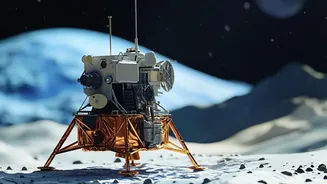
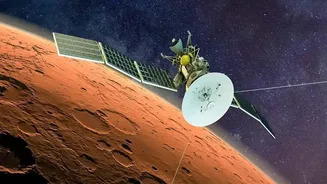
The primary goal of Chandrayaan-3 was clear: execute a flawless soft landing on the Moon's south pole. But ISRO, in a display of remarkable foresight and efficiency, added a secondary objective. The Propulsion Module, the part of the spacecraft that carried
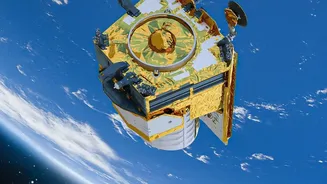
the Vikram lander and Pragyan rover to lunar orbit, was not designed to simply become space debris after its main job was done. Instead, it carried a single, ingenious scientific instrument: SHAPE, or the Spectro-polarimetry of HAbitable Planet Earth. The idea was simple yet profound: before we search for habitable planets trillions of kilometres away, let's first study the one we know is teeming with life—Earth—from a great distance. This would establish a reliable baseline, a 'how-to' guide for identifying Earth-like worlds in the future.
The Science of SHAPE
The SHAPE payload is a spectro-polarimeter. In simple terms, it's an instrument that analyses light. Every planet reflects sunlight, and the properties of this reflected light change based on what's in the planet's atmosphere and on its surface. SHAPE was designed to look at Earth from its vantage point in lunar orbit and analyze the light bouncing off our world. It measures two key things. First, the spectrum of the light, which reveals the chemical composition of the atmosphere, such as the presence of gases like oxygen, carbon dioxide, and water vapour. Second, it measures the light's polarization—the orientation of the light waves. This signature can reveal the presence of clouds, oceans, and even vegetation. By capturing these unique spectral and polarimetric fingerprints of Earth, SHAPE created a detailed profile of a known habitable planet.
Treating Earth as an Exoplanet
From lunar orbit, Earth appears as just a small, distant disc of light, much like how an exoplanet—a planet orbiting another star—appears through our most powerful telescopes. This was the core of the experiment: to observe Earth as if it were a faraway alien world. By studying the disc-integrated light (the light from the entire planet combined), scientists can learn what signatures to look for when they examine distant exoplanets. For example, the specific way light is polarized by Earth's vast oceans or the way our atmosphere's oxygen absorbs certain wavelengths provides a template. When astronomers point future, more powerful telescopes at a rocky exoplanet in a star's habitable zone, they can compare its light signature to the data collected by SHAPE. A close match could be a thrilling indication that the exoplanet might have similar conditions, like clouds, oceans, and perhaps even a life-sustaining atmosphere.
A Bonus Round of Science
The SHAPE experiment was initially planned for the duration the Propulsion Module remained in lunar orbit. However, ISRO engineers realised the module had a significant amount of fuel left after successfully deploying the lander. In a clever manoeuvre, they guided the module out of lunar orbit and placed it into a high, elliptical orbit around Earth in October 2023. This extended the life of the SHAPE experiment, allowing it to continue its observations of Earth from different distances and angles, providing even richer data. This bonus science was not part of the original plan but became possible due to the mission's flawless execution and the surplus fuel, turning the Propulsion Module into a long-term Earth observatory. This move showcased the frugal innovation and resourcefulness that has become a hallmark of India's space program.