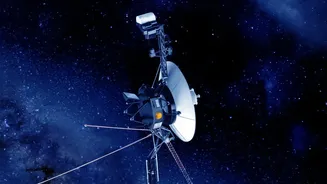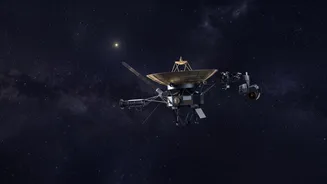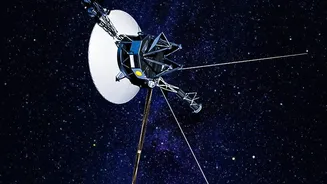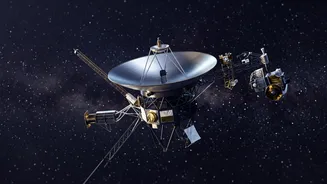


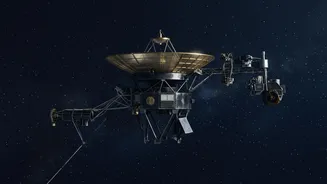
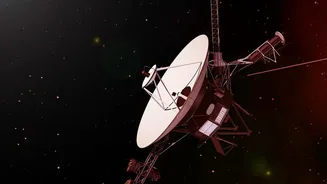
Nearly 50 years after leaving Earth, a lone traveller is about to mark a new line in the cosmic sand. On November 18, 2026, NASA's Voyager 1 will become the first human-made object to be a full light-day away from us. What does that mean?
What Exactly Is a Light-Day?
A light-day isn't
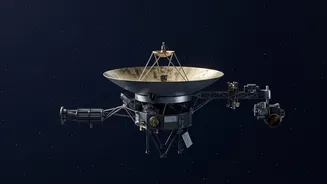
a measure of time, but of immense distance. It's how far a particle of light travels in a vacuum in 24 hours. Light moves at nearly 300,000 kilometres per second, so a light-day equates to a staggering 25.9 billion kilometres. To put that in perspective, light from our own Sun takes about eight minutes to reach Earth. Neptune, the most distant planet in our solar system, is about four light-hours away. For Voyager 1, which has been travelling at roughly 61,000 kilometres per hour since its launch in 1977, covering this distance will have taken just over 49 years. This milestone on November 18 is purely symbolic—the probe won't feel a bump or cross a finish line—but it serves as a powerful illustration of the scale of space and the endurance of this incredible machine.
A 48-Hour 'Hello'
The most tangible consequence of this distance is the profound communication delay. Since radio signals travel at the speed of light, sending a command to Voyager 1 will now take a full 24 hours. Then, mission controllers on Earth must wait another 24 hours for a response, making the round-trip communication time a minimum of 48 hours. This incredible lag makes managing the spacecraft's health a slow and deliberate process. Engineers recently had a scare in October 2026 when they lost contact with the probe for 48 hours. Communication was re-established, but the incident highlighted the growing challenges of operating a nearly 50-year-old probe across such an unfathomable void.
A Journey for the History Books
Launched on September 5, 1977—just after its twin, Voyager 2—Voyager 1's original mission was to study Jupiter and Saturn. It performed spectacularly, discovering Jupiter's faint rings, active volcanoes on its moon Io, and several of Saturn's moons. After its flyby of Saturn's moon Titan in 1980, its planetary mission ended, and its trajectory sent it hurtling toward the edge of the solar system. In 1990, it turned its camera back one last time to take the iconic 'Pale Blue Dot' photograph of Earth from 6.4 billion kilometres away. It officially entered interstellar space in 2012, becoming the first human-made object to leave the Sun's protective bubble, known as the heliosphere.
Keeping an Ageing Explorer Alive
Voyager 1 was only designed to last for five years. Its continued operation is a triumph of engineering and creative problem-solving. The spacecraft is powered by a plutonium generator that is slowly losing power, producing about four fewer watts each year. To keep its scientific instruments running, NASA engineers have been forced to shut down non_essential systems, including its cameras years ago. Recently, a clever power_saving manoeuvre nicknamed the 'Big Bang' was executed to extend the life of its remaining instruments. Despite recent communication glitches and dwindling power, the team hopes to keep receiving valuable data from interstellar space for a few more years, possibly until the $2030s.
What's Next for Our Farthest Emissary?
After crossing the light_day milestone, Voyager $1$'s journey will continue in silence and solitude. It will keep travelling through the interstellar medium, a region of space filled with material from stars that exploded millions of years ago. It will not pass close to another star for a very long time. In about $40$,$000$ years, it is projected to come within $1$.$7$ light_years of a star called AC +$79$ $3888$. By then, its power will have long since faded. The probe carries a 'Golden Record'—a gold_plated copper disk containing sounds and images from Earth—as a message for any potential extraterrestrial civilization that might one day find it. Long after it stops communicating with us, Voyager $1$ will continue its journey as a silent ambassador, a testament to the human desire to explore what lies beyond our own small world.