




How Autonomous is the Rover, Really?
A common misconception about Mars rovers is that they are driven like remote-controlled cars. The reality is far more complex due to the significant time delay in communications between Earth and Mars, which can be up to 25 minutes for a round trip. For
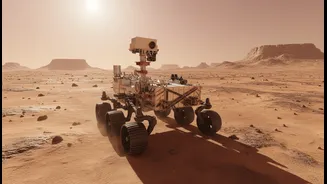
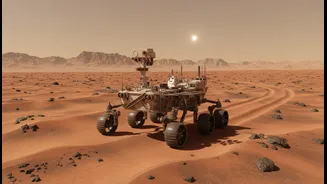
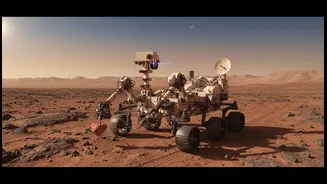
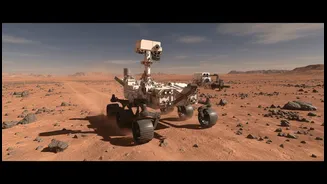
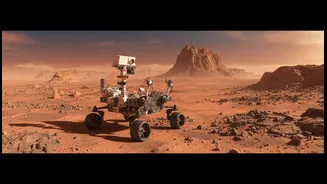
years, human planners on Earth would meticulously map out short routes, sending waypoints for the rover to follow. Perseverance, however, has fundamentally changed the game with its advanced autonomous navigation system, AutoNav. This system allows the rover to map the terrain ahead, identify hazards like rocks and sand traps, and plot its own course between specified points while on the move. In fact, over 90% of all driving is now done autonomously. In a landmark demonstration in late 2025, NASA even allowed a generative AI to plan the rover's route for two full days, showcasing a new frontier in robotic exploration where machines can make more high-level decisions with less human guidance.
What About Maintenance and Wear?
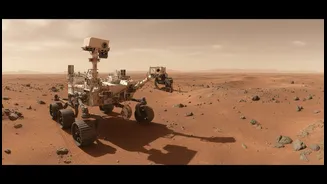
There are no mechanics on Mars. Every component on Perseverance must be durable enough to survive years of harsh conditions, from extreme temperature swings to jagged rocks. A key area of concern for any rover is wheel damage. Perseverance's older cousin, the Curiosity rover, suffered significant wear to its thin aluminum wheels, with numerous punctures and cracks accumulating over its mission. This damage forced its mission planners to become much more cautious, avoiding certain terrain and limiting the use of autonomous driving to reduce stress on the wheels. Engineers at NASA's Jet Propulsion Laboratory (JPL) learned critical lessons from this. The wheels on Perseverance were redesigned to be more robust, with a different tread pattern to better withstand the punishing surface. So far, the design has proven successful. After years of driving, ground-based testing of replica parts shows the rover's systems are in excellent shape and certified to continue operating for many more years, potentially until at least 2031.
What are the Limits of Mobility?
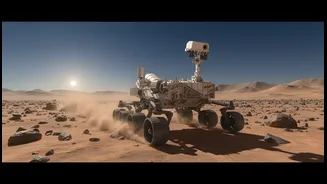
Perseverance is a record-breaker. As of mid-2026, the rover has traveled over 43 kilometers, completing the equivalent of a marathon in less than half the time it took the previous record-holder, Opportunity. This enhanced speed and range are direct results of its superior autonomous navigation. The 'thinking while driving' capability allows it to cover more ground safely, giving scientists more time to conduct experiments and analyze promising locations. The rover's primary mission is to explore the ancient river delta in Jezero Crater, seeking signs of past microbial life and collecting compelling rock and soil samples. It has already identified several high-priority targets, including rocks with organic molecules that could be potential biosignatures. While the ambitious Mars Sample Return mission to bring these samples back to Earth has faced uncertainty, the rover continues to cache them for a potential future retrieval. The rover's long-duration mobility is therefore not just about distance, but about maximizing the scientific return from this incredible mission.
What Do We Learn for Future Missions?
Perseverance is more than just a science mission; it's a crucial technology demonstrator for the future of space exploration, including eventual human missions. The lessons learned from its autonomous driving systems are paving the way for next-generation robots that can explore more distant and challenging worlds with even greater independence. Technologies tested on Perseverance, such as the MOXIE experiment that successfully produced oxygen from the Martian atmosphere, provide invaluable data for designing life support systems for future astronauts. Furthermore, the ongoing analysis of the rover's durability informs the design of everything from habitats to power systems needed for a sustained human presence on Mars. Every kilometer driven and every rock analyzed by Perseverance provides not just clues about Mars's past, but a detailed engineering roadmap for humanity's future in space.