



Why Water Is the Holy Grail
On Earth, from the deepest oceans to the driest deserts, wherever we find liquid water, we find life. This makes the presence of water a top priority for scientists searching for habitable conditions elsewhere. While science fiction often depicts desert worlds,
recent research suggests planets need a significant amount of water to sustain the geological cycles that keep a world habitable over billions of years. Finding water, therefore, isn't just about ticking a box; it's about finding a world with the potential for a stable, life-supporting environment. The mantra for many astrobiologists is simple: follow the water.
The Art of Starlight Forensics
So, how do you find water on a planet light-years away? The primary method is called transit spectroscopy. When an exoplanet passes in front of its host star from our point of view, a tiny fraction of the starlight filters through the planet's atmosphere. Different gases in that atmosphere absorb specific colours, or wavelengths, of light. Water vapour leaves a unique and identifiable signature on the starlight that reaches our telescopes. By analyzing this 'transmission spectrum', astronomers can identify the chemical makeup of the atmosphere, essentially performing a chemical analysis from across the galaxy.
A Generational Leap in Technology
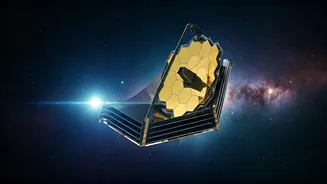
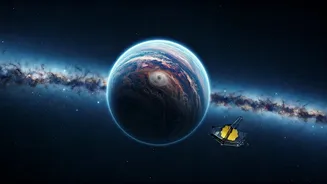
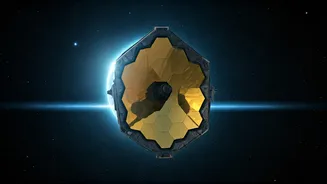
For years, the Hubble Space Telescope did the heavy lifting, providing the first tantalizing hints of water on distant worlds like K2-18b. But the game truly changed with the deployment of the James Webb Space Telescope (JWST). JWST is far more powerful and specifically designed to perform this kind of atmospheric analysis with unprecedented precision. Before Webb, many attempts to study atmospheres resulted in frustratingly featureless readings, possibly due to thick clouds. Webb's enhanced sensitivity can peer deeper and detect fainter signals, allowing it to identify water vapour even in the planet-forming disks around young stars, suggesting that rocky planets may have access to water from the very beginning.
From Theory to Landmark Detections
The detection of water vapour on the super-Earth K2-18b, which lies in its star's habitable zone, was a landmark moment. It was the first time water was found on a potentially temperate world, though its large size makes it more like a 'mini-Neptune' than a large Earth. Since then, JWST has confirmed water on a variety of planets, from hot 'sub-Neptunes' to rocky worlds. In some cases, as with the planet GJ 9827d, the discovery was a milestone for finding water on a planet only twice Earth's diameter. Recently, in June 2026, the discovery of a nearby 'super-Earth' named GJ 3378b has excited astronomers because it sits squarely in its star's habitable zone, receiving almost the same amount of light as Earth.
Not Just Water, but the Right Address
Detecting water vapour is a monumental step, but it doesn't automatically mean a planet is habitable. The planet's location, known as the 'habitable zone', is crucial. This is the 'Goldilocks' orbit where temperatures are just right for liquid water to potentially exist on the surface. A planet like K2-18b has water vapour and the right temperature, but its immense size and thick hydrogen atmosphere might mean any 'surface' would have crushing pressures. The ultimate goal is to find water vapour on a rocky, Earth-sized planet within that habitable zone—a world that is not too big, not too hot, and not too cold.