





The Coronal Conundrum
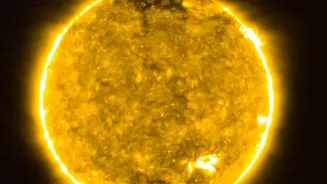
Imagine walking away from a bonfire and feeling the air get hotter. It defies logic, yet this is precisely what happens on the sun. Its visible surface, the photosphere, burns at a blistering 5,500 degrees Celsius. But its outer atmosphere, the corona,
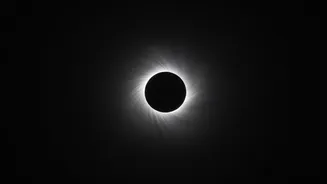
which is visible as a pearly crown during an eclipse, sizzles at over a million degrees. This mystery, known as the coronal heating problem, has puzzled solar physicists for decades. How is energy being transported from the cooler surface to superheat the atmosphere hundreds of thousands of kilometres away? Solving this is key to understanding not just our sun, but other stars throughout the universe. Theories range from constant, tiny explosions called nanoflares to the effects of magnetic waves, but definitive proof remains elusive.
A Perfect Natural Laboratory
While space agencies have sophisticated instruments called coronagraphs to block the sun's glare, none can perfectly replicate what the moon does naturally. During a total solar eclipse, the moon acts as a perfect occulter, blocking the intensely bright disk of the sun. This allows scientists to see the faint, intricate structures of the inner corona with unparalleled clarity from the ground and sky. It’s a fleeting chance, lasting only minutes, to gather data that is difficult or impossible to obtain otherwise. This data helps test and refine theories about the corona's mysterious heat source and how it drives the solar wind, the stream of charged particles that flows past Earth.
NASA's High-Flying Science Mission
To maximize this rare opportunity, NASA didn't just watch from the ground. The agency deployed one of its WB-57 high-altitude research aircraft to chase the moon's shadow from 50,000 feet above the clouds over Iceland. By flying at 460 miles per hour along the eclipse path, the jet extended its view of totality to nearly three minutes, significantly longer than the maximum two minutes and 18 seconds available on the ground. A suite of advanced cameras in the plane's nose, called SAMI, captured high-resolution images of the corona in multiple wavelengths of light, aiming to trace the flow of energy and the relationship between the corona and the solar wind.
A Global Scientific Effort
NASA's airborne mission was just one part of a broader international scientific campaign. The eclipse's path across Greenland, Iceland, and Spain provided numerous vantage points. In Iceland and Spain, student teams funded by NASA launched dozens of scientific balloons to study how the sudden drop in sunlight affects Earth’s boundary layer, the part of the atmosphere closest to the ground. Meanwhile, the European Space Agency (ESA) coordinated observations from its Solar Orbiter spacecraft to provide a different perspective, helping to build a more complete three-dimensional model of the corona’s magnetic field. Each eclipse provides new data because the sun's activity is constantly changing, meaning the corona's appearance is never the same twice.
What Happens to the Data Now?
The work for scientists has only just begun. The terabytes of data collected from jets, balloons, and ground-based telescopes will now be meticulously analyzed. These new observations will be compared with data from ongoing missions like NASA's Parker Solar Probe, which is actually flying through the corona to take direct measurements. By combining the close-up data from Parker with the wide-view context from the eclipse, scientists hope to finally piece together the puzzle of coronal heating. Understanding our star's behaviour is not just an academic pursuit; it is crucial for improving space weather forecasts, which can affect everything from satellite communications and GPS to power grids on Earth.