
Decoding a Planet's Atmosphere from Light-Years Away
Studying a planet you can't even see directly sounds like science fiction, but it's a daily reality for astronomers. Since exoplanets are too small, dim, and distant to photograph in detail, scientists use a clever method called transit spectroscopy.
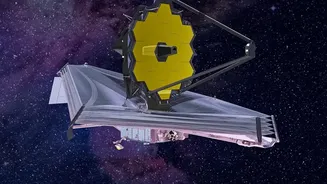
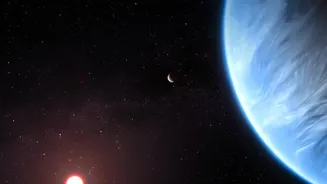
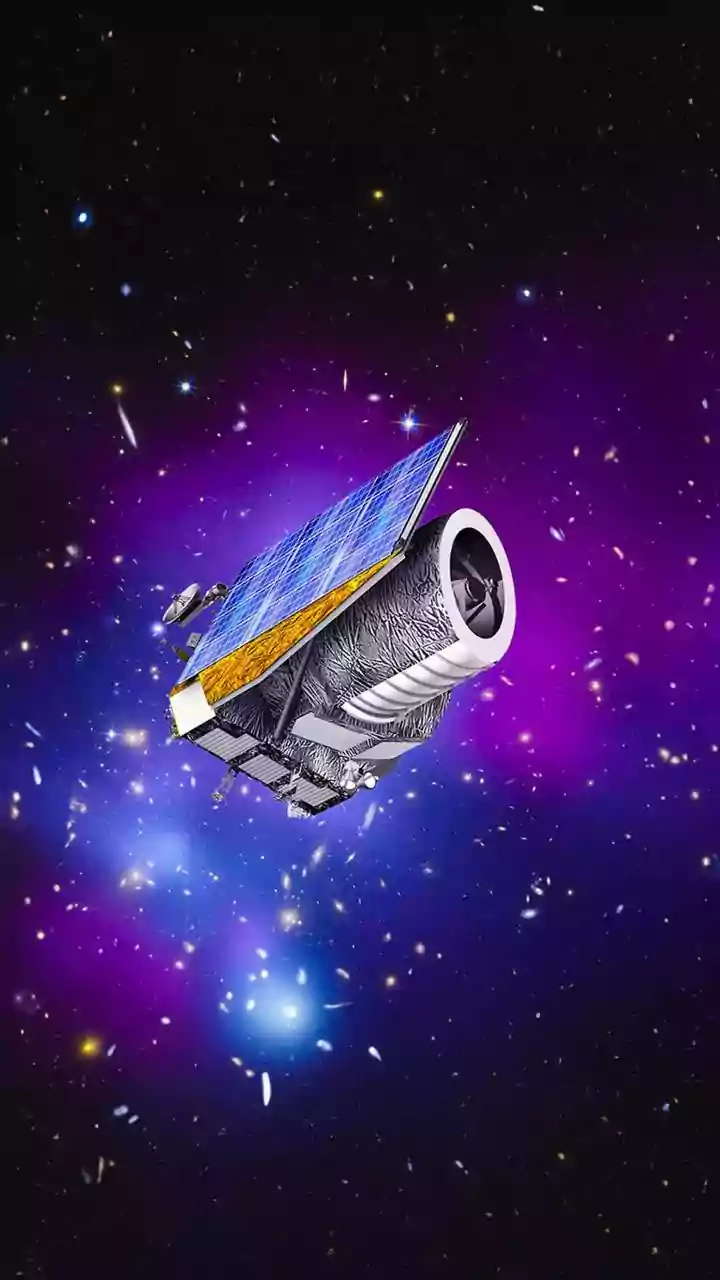
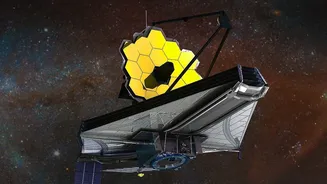
When an exoplanet passes in front of its host star from our point of view, a tiny fraction of the starlight filters through the planet's atmosphere. Different chemical elements and molecules in that atmosphere absorb light at very specific wavelengths, leaving a unique chemical 'fingerprint' on the light that reaches our telescopes. By analysing which colours of light are missing, astronomers can deduce what the atmosphere is made of, from water vapour to vaporised metals. Powerful instruments, especially those on the James Webb Space Telescope (JWST), are sensitive enough to pick up these faint signals and give us an unprecedented view of the chemistry on worlds far beyond our solar system.
The Planet with Molten Iron Rain
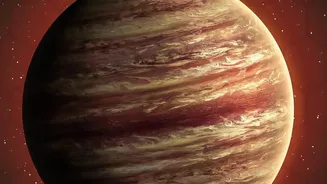
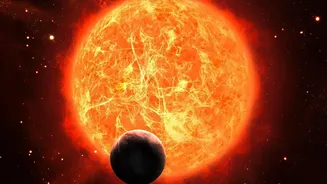
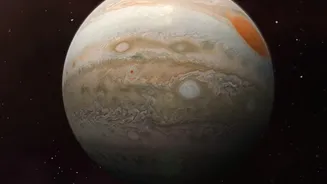
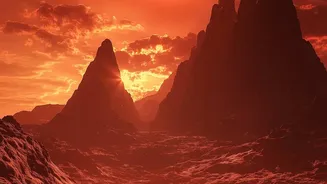
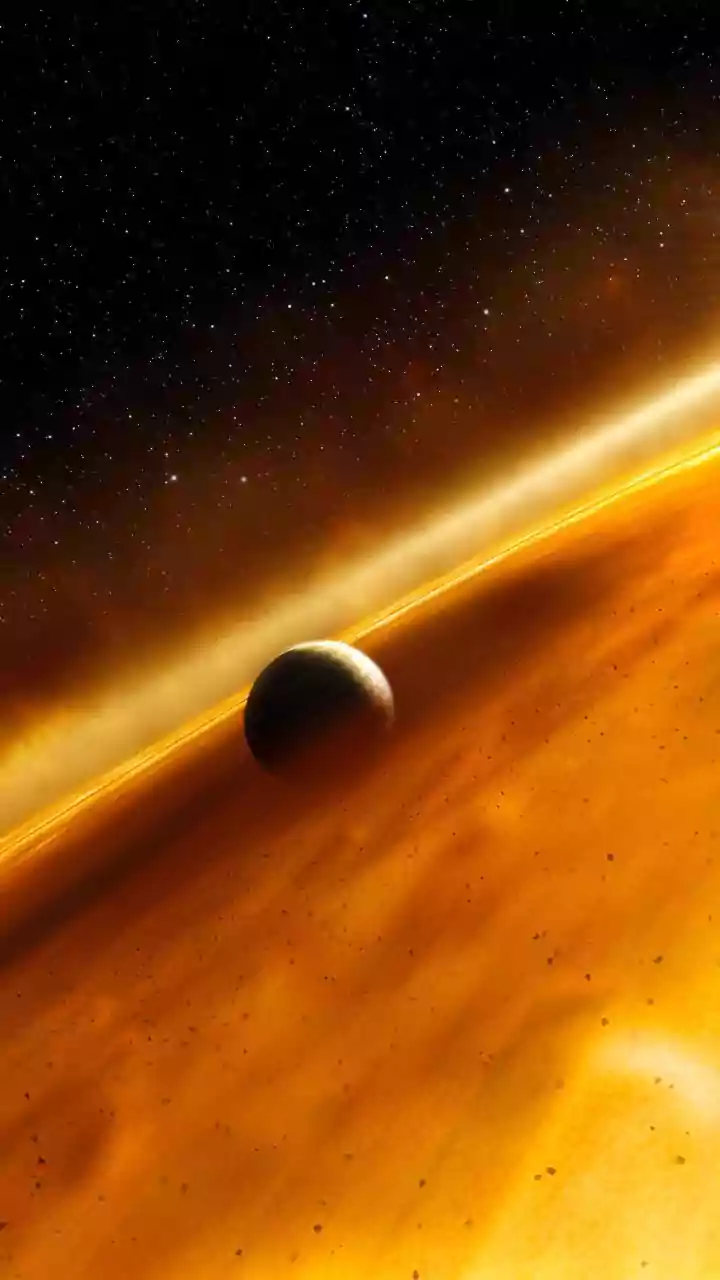
The poster child for extreme exoplanet weather is WASP-76b, a behemoth located about 640 light-years away. This 'hot Jupiter' is tidally locked to its star, meaning one side perpetually faces the blistering heat while the other is in permanent night. The day side gets so hot—over 2,400 degrees Celsius—that metals like iron vaporise into the atmosphere. Powerful winds then whip this iron vapour across the planet to the cooler night side. There, as temperatures drop to around 1,500 degrees Celsius, the iron condenses into clouds and falls to the surface as droplets of molten iron rain. So, on WASP-76b, the evening forecast isn't just rainy; it's a downpour of liquid metal.
Creating an Alien Weather Map
To create a weather map, scientists track the planet throughout its orbit. By measuring the faint infrared light, or heat, emitted by the planet at different phases, they can build a picture of its temperature distribution. This is known as creating a 'phase curve'. These maps reveal how heat is transported across the planet. A large temperature difference between the day and night sides might suggest a thin atmosphere, while more even temperatures point to strong winds circulating heat. For a planet like WASP-76b, this technique helps confirm the model of hot, iron-rich air moving from the day side to the night side, providing the evidence for its metallic downpours. The JWST has taken this even further, distinguishing between cloudy and clear regions on distant worlds and observing daily weather cycles for the first time.
A Universe of Wild Weather
Iron rain is just the beginning. The universe is full of planets with weather systems that make Earth's most violent storms seem tame. On exoplanet HD 189733b, for instance, scientists have detected evidence of sideways rain made of molten glass, driven by winds blowing at over 8,700 kilometres per hour. Other worlds may have clouds of sand made from silicate minerals. On some planets, temperatures are hot enough to vaporise rock, which then could condense and rain back down onto magma oceans. Astronomers have even found a planet, WASP-121b, where the extreme temperatures and atmospheric composition could lead to clouds that rain rubies and sapphires. These bizarre discoveries show that the physics and chemistry we understand on Earth can produce truly alien outcomes under extreme conditions.
Why We Study Extreme Weather
Mapping these alien climates is more than just a cosmic curiosity. It provides a laboratory for testing our understanding of atmospheric physics under conditions that don't exist in our solar system. This research helps scientists refine their models of how planets form and evolve. Every new atmosphere catalogued, no matter how hostile, adds another piece to the puzzle of planetary diversity. Ultimately, understanding how atmospheres behave on a wide range of planets is a crucial step in the search for life. By learning to identify the tell-tale signs of different atmospheric components, scientists are honing the skills and technology that could one day detect the chemical signatures of a habitable, or even inhabited, world.