


The Cosmic Speed Limit
Everything in the universe has a speed limit, and light is the undisputed champion. It travels at an astonishing 300,000 kilometres per second. While that sounds instantaneous, space is unimaginably vast. Because of this, it takes time for the light from
distant objects to reach our eyes. This is where the concept of a 'light-year' comes in. It’s not a measure of time, but of distance—specifically, the distance light travels in one year, which is about 9.5 trillion kilometres. When we say a star is 100 light-years away, we mean the light we are seeing from it tonight actually left that star 100 years ago. In essence, the night sky is not a live broadcast; it's a recording of the past.
A Historical Tour of the Stars
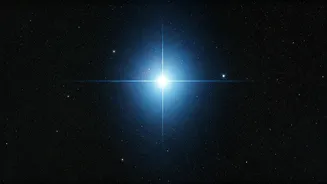
Let’s take a walk through the stars you can see from India. Take Sirius, the brightest star in our sky. It’s relatively close, at just 8.6 light-years away. The light you see from it tonight left around the time the first UPI transactions were becoming commonplace. Now consider Polaris, the North Star, a reliable guide for centuries. It’s approximately 433 light-years away. That means the light hitting your retina left Polaris around the year 1591, when the Charminar was being completed in Hyderabad. Think about that: a beam of light travelled through space during the entire reign of the Mughal emperor Shah Jahan, the construction of the Taj Mahal, the rise and fall of the British Raj, and the birth of modern India, only to end its journey in your eye tonight.
When a Star Dies in Secret
This cosmic time lag has even more dramatic implications. Consider the red supergiant Betelgeuse, one of the most famous stars in the constellation Orion. It's about 640 light-years from Earth. Astronomers know that Betelgeuse is at the end of its life and will eventually explode in a spectacular supernova. The thing is, it might have already happened. The explosion could have occurred in the 14th century, and we would be none the wiser. The news of its death, travelling at the speed of light, simply hasn't reached us yet. We continue to see a star that may no longer exist, a ghost in the cosmic graveyard. This is true for countless stars; we are only seeing their past selves, with no guarantee that their present is the same.
Looking at Entire Galaxies
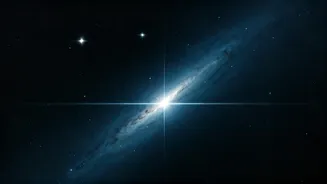
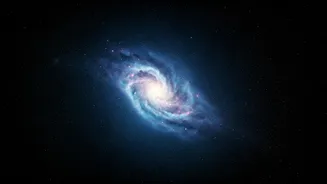
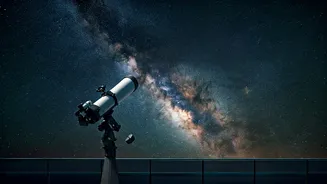
The principle extends to scales that are hard to even comprehend. On a very clear, dark night, far from city lights, you might be able to spot a faint, fuzzy patch in the sky. That is the Andromeda Galaxy, our closest major galactic neighbour. It contains a trillion stars, and the light from it has taken 2.5 million years to reach us. When that light began its journey, our earliest human ancestors, of the genus *Homo*, were just beginning to walk the Earth. We are seeing Andromeda not as it is today, but as it was in the distant prehistoric past. Every telescope, from the Hubble to the James Webb Space Telescope, is fundamentally a time machine, showing us snapshots of cosmic history, from the birth of stars to the collision of ancient galaxies.