





A Cold Case Reopened
The story begins with a cosmic mystery locked in data from 1999. Back then, the Hubble Space Telescope observed a white dwarf star named HS 0209+0832, located about 270 light-years away. Its light spectrum contained strange chemical signatures that scientists
couldn't identify. More than two decades later, a team led by astronomers from the University of Warwick revisited this old data. Armed with updated databases, they found that many of the mystery signals belonged to an element called niobium, alongside other heavy elements like zinc and copper. This chemical cocktail was highly unusual for a white dwarf, which typically shows signs of absorbing rocky material from asteroids.
The Ghost of a Sun-Like Star
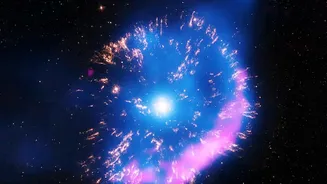
To understand why this is so strange, you need to know what a white dwarf is. It's the ultra-dense core left behind after a star like our own Sun runs out of fuel. In about six billion years, our Sun will swell into a red giant, likely engulfing the inner planets, before shedding its outer layers. What remains will be a hot, compact white dwarf. The white dwarf HS 0209+0832 is the remnant of such a star. Its existence is a preview of our solar system's distant future. The planets in our solar system are 'first-generation' worlds, formed from the disk of gas and dust that surrounded the Sun at its birth. Any such planets around the original star that became HS 0209+0832 would have been destroyed during its red giant phase.
A Planet Reborn from Ashes
The presence of niobium is the smoking gun. Unlike common elements, niobium is not forged in the core of a star during its normal life. Instead, it's created during the exotic, high-energy conditions of a star's death throes. This means the material couldn't have come from a first-generation planet. The leading theory is that this planet is a 'second-generation' world, formed from a new disk made of the star's own ejected material. Like a phoenix rising from the ashes, this world appears to have condensed from the very debris of the star it now orbits. This is the first time a candidate for such a planet has been found around a white dwarf, a much more common stellar remnant than the pulsars where similar worlds have been theorised.
A World Under Fire
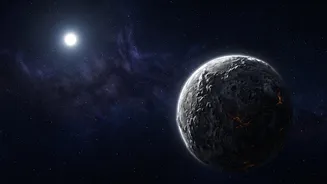
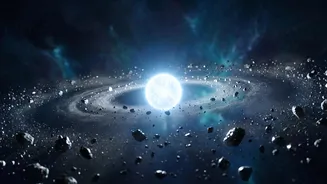
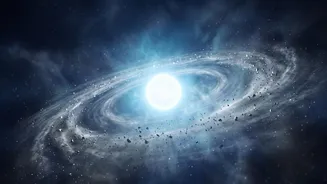
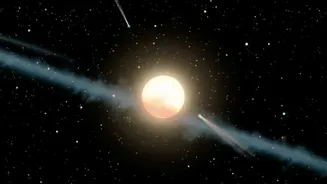
Further observations from NASA's TESS satellite detected periodic dips in the star's brightness, suggesting a Jupiter-sized gas giant is orbiting incredibly close to the white dwarf. Its orbit is estimated to be just 4.4 days long, placing it about ten times closer to its star than Mercury is to our Sun. At this proximity, the planet is being blasted by intense radiation from the hot, young white dwarf. Astronomers believe this is causing the planet's atmosphere to be stripped away, forming a disk of material that is then raining down onto the star's surface. This process, called accretion, would explain why the white dwarf's atmosphere is enriched with the very elements that make up the planet.
A Glimpse into Cosmic Futures
While the planet around HS 0209+0832 is still a candidate awaiting final confirmation, its discovery opens a new chapter in our understanding of planetary science. It demonstrates that planet formation is not a one-time event that only happens around young stars. New worlds can be built even in the extreme environment surrounding a stellar remnant. This finding raises the tantalising question of whether our own solar system could one day host a second generation of planets, formed from the material of our dying Sun. For now, scientists will continue to study this fascinating system, searching for more clues about this resurrected world and what it can teach us about the life, death, and rebirth of planetary systems across the galaxy.