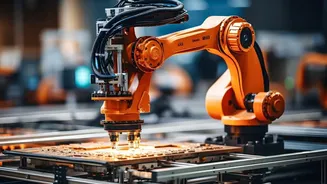









Asia's Looming Workforce Crisis
For decades, Asia's economic miracle was powered by an abundant and youthful labour force. That era is now ending for many of the continent's powerhouses. According to recent findings from the International Monetary Fund (IMF), countries like Japan, South
Korea, and China could see their working-age populations shrink by nearly 25% by the year 2050. This demographic shift poses a fundamental threat to economic growth. Fewer workers can mean lower productive capacity, a smaller tax base to support social services like pensions and healthcare, and a general economic slowdown. Speaking at the IMF and World Bank annual meetings in Bangkok, IMF Managing Director Kristalina Georgieva identified this demographic pressure as one of the three great transformations facing Asia, alongside technological change and economic integration.
AI as a Productivity Engine
The IMF's analysis suggests that artificial intelligence, often viewed as a threat to jobs, could be the key to offsetting this demographic drag. The logic is straightforward: if there are fewer people to do the work, each person needs to become significantly more productive. AI and automation can achieve this by augmenting human capabilities and handling tasks more efficiently. The IMF projects that widespread AI adoption could boost annual growth by 0.5 to 1 percentage point in advanced Asian economies. Georgieva noted that if these nations fully capture these productivity gains, they could more than compensate for the economic pressure caused by a shrinking workforce. This represents a critical shift from relying on more labour to relying on smarter labour.
The Risk of a New Divide
However, the IMF warns that these benefits will not be automatic or evenly distributed. A significant risk is the creation of a 'new divergence' between the region's advanced economies and its emerging markets. Nations like Japan and South Korea have the capital, digital infrastructure, and highly-skilled workers to quickly deploy and benefit from AI. In contrast, emerging economies are less exposed to the initial disruption but also far less prepared to capture the upside. Krishna Srinivasan, director of the IMF's Asia and Pacific department, highlighted this gap, noting that advanced economies are simply better positioned to benefit. Without the right policies, AI could widen the economic gap between Asia's rich and poor nations.
Augmenting Workers, Not Just Replacing Them
The central question, as framed by Srinivasan, is 'whether AI augments workers or automates jobs'. The fear of mass job displacement is real, and the IMF acknowledges that AI, described by Georgieva as a 'slow-moving tsunami', will have profound consequences for employment. Their analysis suggests that globally, about 40% of jobs are exposed to AI in some way, with that figure rising to 60% in advanced economies. However, the focus shouldn't solely be on jobs lost. In many cases, AI will complement human skills, especially in professional, managerial, and technical roles, boosting the productivity of those who can adapt. The challenge lies with lower and middle-skilled workers in roles more susceptible to outright automation, highlighting an urgent need for new social safety nets and large-scale reskilling programmes.
The Path Forward: Investment and Reform
Realising AI's potential as a demographic solution requires more than just technology; it demands proactive policy. The IMF stresses that emerging markets can accelerate AI adoption by a decade or more through targeted reforms. This includes heavy investment in digital infrastructure and, crucially, in human capital. Governments must overhaul education and create robust training programmes to prepare their workforces for an AI-driven economy. Furthermore, the IMF points out that other reforms, such as deepening regional trade agreements and lowering non-tariff barriers, could provide an additional boost to Asia's GDP. The message is clear: technology on its own is not a silver bullet. Its success will depend on a concerted effort to build an inclusive and prepared society around it.