



The Quintessential Thali: Dal Baati Churma
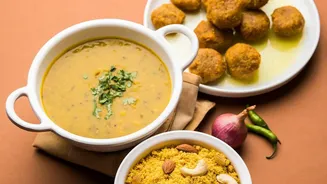
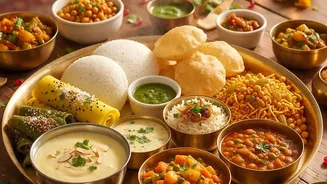
No culinary exploration of Rajasthan is complete without surrendering to the delights of Dal Baati Churma. This isn't just a meal; it's a cultural emblem. The dish consists of three distinct parts that create a perfect harmony of textures and tastes.
The 'dal' is a spicy lentil curry, often a mix of several lentils like toor and chana, simmered with aromatic spices like cumin and asafoetia. The 'baati' are hard, unleavened wheat rolls that are traditionally baked in a clay oven or over open flames until they are crusty on the outside and soft within. Before serving, these golden orbs are cracked open and generously drenched in ghee. The 'churma' provides a sweet counterbalance; it's made by crumbling baked baati and mixing it with ghee and jaggery or sugar, often garnished with nuts. This trio originated as a hearty meal for warriors, designed for longevity and high energy, and remains a beloved staple at festivals and family gatherings today.
A World of Curries
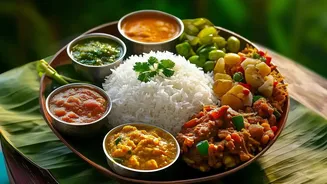
While Dal Baati Churma is the star, a Rajasthani thali is a constellation of flavours. One of the most iconic vegetarian curries is 'Gatte ki Sabzi'. These are tender dumplings made from gram flour (besan), which are steamed and then simmered in a tangy, spicy yogurt-based gravy. Its origins lie in the need to create delicious food with minimal fresh vegetables, a common challenge in the desert region. Another unique preparation is 'Ker Sangri'. This dish is a tangy and spicy stir-fry made from ker, a desert berry, and sangri, a type of long bean. It’s a true taste of the local landscape, a delicacy born from the sparse vegetation of the Marwar region. Often, a thali will also feature a 'Panchmel Dal', a nutritious and flavourful curry made by mixing five different types of lentils.
Hearty Breads and Accompaniments
The breads of Rajasthan are as robust as its landscape. Due to the scarcity of wheat in some areas, millets like bajra (pearl millet) and grains like makai (corn) are used extensively. A 'Bajra Roti' is a dense, smoky flatbread that pairs perfectly with the spicy curries and a dollop of garlic chutney. Similarly, 'Missi Roti' is a flavourful flatbread made from a mix of whole wheat flour and gram flour, spiced with herbs. To cool the palate, a bowl of 'Boondi Raita' is essential. This refreshing side dish consists of tiny fried gram-flour balls (boondi) soaked in cool, seasoned yogurt. Another common side is 'Aam ki Launji', a sweet and sour chutney made from raw mangoes that adds an extra kick to the meal.
Unmissable Street-Side Snacks
The culinary adventure continues on the streets. 'Pyaaz ki Kachori', a flaky, deep-fried pastry filled with a spicy onion mixture, is a beloved breakfast snack, especially popular in Jodhpur and Jaipur. It’s often served hot, sometimes crushed and topped with various chutneys. Another fiery favourite is the 'Mirchi Vada', a large green chilli stuffed with a spiced potato filling, coated in gram flour batter, and deep-fried to golden perfection. It delivers a powerful punch of heat and flavour that is quintessentially Rajasthani.
A Royal Sweet Finish
Rajasthan’s desserts, or 'mithai', are rich, indulgent, and often soaked in ghee and sugar syrup, a tradition influenced by royal kitchens. 'Ghevar' is perhaps the most iconic sweet, a disc-shaped, honeycomb-like cake made from flour and ghee, then drenched in sugar syrup. It's especially popular during festivals like Teej and Raksha Bandhan. For a unique blend of sweet and savoury, try 'Mawa Kachori' from Jodhpur. This pastry is filled with sweetened khoya (milk solids) and nuts, then deep-fried and dipped in sugar syrup. Other must-try sweets include the flaky 'Balushahi', soft 'Malpua' pancakes, and the ever-popular 'Churma Ladoo', which transforms the thali's sweet component into a standalone dessert.