

First, A Quick Trip Around the Sun
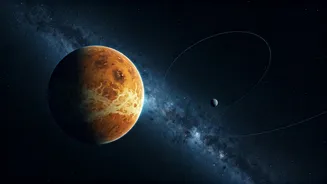
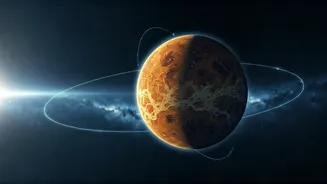
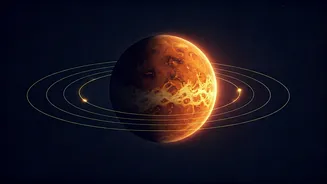
Let’s start with the easy part: a Venusian year. Like every planet, a year on Venus is defined by the time it takes to complete one full orbit around the Sun. Venus is closer to the Sun than Earth, so its orbital path is shorter and it moves faster. While
Earth takes a familiar 365 days to make the journey, Venus zips around in just about 225 Earth days. So, if you were living on Venus, you'd celebrate your birthday every 225 days. Simple enough. This swift journey is the 'solar trip' mentioned in the headline, and it sets the stage for the planet's bizarre timekeeping.
The Longest, Slowest Day Imaginable
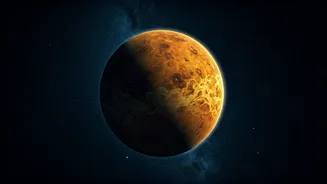
Now for the complicated part: the Venusian day. A 'day' can mean two things. The first is a sidereal day, which is the time it takes for a planet to complete one full 360-degree rotation on its axis. Earth does this in about 23 hours and 56 minutes. Venus, however, is extraordinarily lazy. It spins so slowly that one full rotation takes a staggering 243 Earth days. Pause and let that sink in. A single spin of the planet (243 days) takes longer than its entire orbit around the Sun (225 days). This is the core of the paradox. Before the planet has even finished turning around once, it has already completed a full year.
It's Also Spinning the Wrong Way
To make matters even stranger, Venus spins backwards. Nearly every planet in our solar system, including Earth, rotates on its axis counter-clockwise. This is known as prograde motion. Venus, along with Uranus, is an outlier. It has a retrograde rotation, meaning it spins clockwise. If you could stand on the surface of Venus (which you can't, due to the crushing pressure and acid rain), you would see the Sun rise in the west and set in the east. This backward spin is a crucial piece of the puzzle when it comes to understanding the Venusian day as experienced from the ground.
Putting It All Together: The Solar Day
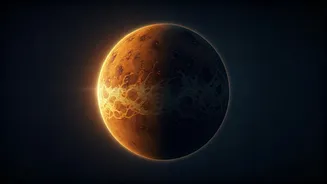
This brings us to the second definition of a day: the solar day. This is what we experience on Earth as the 24-hour cycle from one sunrise to the next. On Venus, the super-slow, backward rotation clashes with its relatively fast orbit to create a very strange effect. Because the planet is rotating clockwise while it orbits the Sun counter-clockwise, the Sun appears to move across the sky much faster than the planet's actual rotation speed would suggest. The result is that the time from one sunrise to the next on Venus—its solar day—is 'only' about 117 Earth days. So, while a single spin (sidereal day) is 243 days long, you’d experience two sunrises in that time. It's a cosmic dance where the slow, backward waltz of the planet’s spin interacts with its quickstep around the Sun, resulting in a day-night cycle that is profoundly alien.
Why is Venus So Weird?
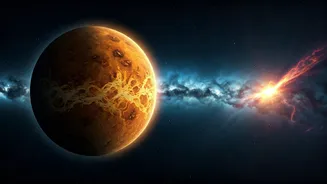
Scientists don't have a definitive answer for Venus's peculiar rotation, but they have some compelling theories. One leading hypothesis suggests that Venus may have been struck by a massive asteroid or planetesimal early in its history. Such a cataclysmic impact could have been powerful enough to slow its original rotation to a crawl and even flip it upside down, resulting in the retrograde spin we see today. Another theory points to its incredibly thick, heavy atmosphere. Some models suggest that atmospheric tides, created by solar heating, could have exerted a powerful braking force on the planet over billions of years, slowing its rotation and eventually locking it into its current strange rhythm. It's likely a combination of ancient impacts and long-term atmospheric effects.