
First Steps for Stargazers
You don’t need expensive equipment to begin your cosmic journey; the best tool is your own curiosity. The first and most important step is to find a dark spot away from the glare of city lights. A rooftop, a local park, or a quick drive away from urban
centres can make a world of difference. Give your eyes at least 20 minutes to fully adapt to the darkness. During this time, resist the urge to look at your phone, as the white light can reset your night vision instantly. If you need a light, use a torch with a red filter, which is less disruptive to your eyes. For identifying stars and planets, smartphone apps like Star Walk or SkyView can act as your digital guide, pointing out celestial objects in real time.
The Ringed Jewel: Saturn
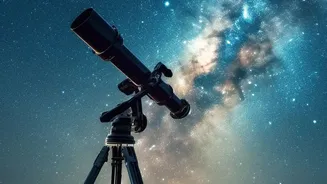
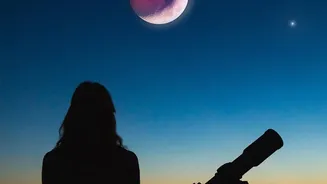
The main attraction for the late August sky is the magnificent planet Saturn. Visible for most of the night, it shines as a steady, golden point of light in the eastern sky during the evening. Unlike stars, which twinkle due to atmospheric disturbance, planets have a constant glow, making them easier to identify. Saturn is currently getting brighter as it heads towards its opposition in early October, when it will be at its closest point to Earth for the year. For an easy-to-spot celestial event, look for the Moon passing close to Saturn on the nights of August 30th and 31st, a beautiful pairing that will help you locate the ringed planet. While its famous rings are only visible through a telescope, its bright presence is a rewarding sight for the naked eye.
Catching the Last Shooting Stars
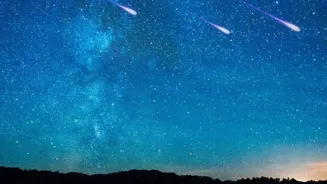
The famous Perseid meteor shower peaked in mid-August, offering a spectacular show. While the peak has passed, the shower remains active until the beginning of September. This means you still have a chance to spot a few lingering “shooting stars” in the final nights of the month. The best time to look is after midnight, when the Earth turns into the path of the cometary debris stream. Find a comfortable spot, lie back, and be patient. Watching for meteors is a game of chance, but even a single, bright streak across the sky can be a magical experience.
A Glimpse of the Milky Way
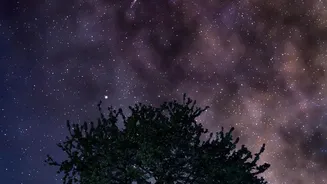
August provides a great opportunity to witness the grandeur of our own galaxy, the Milky Way. From a truly dark location, it appears as a faint, hazy band of light stretching across the sky. The densest and most dramatic part, the galactic core, is located in the direction of the constellation Sagittarius. This part of the sky, low on the southern horizon from India, looks like a cloud of stellar steam. Even if you can only see a faint glow, you are looking at the combined light of billions of distant stars. The monsoon season can make viewing tricky due to humidity and clouds, so take advantage of any clear, crisp night. Places with low light pollution like the Rann of Kutch, Ladakh, or parts of the Western Ghats offer the most breathtaking views.
Connect the Dots: August Constellations
The late summer sky is filled with prominent constellations. One of the easiest to find is the Summer Triangle, an asterism formed by three bright stars—Vega in the constellation Lyra, Deneb in Cygnus, and Altair in Aquila. From India, this will be high overhead in the evening. Look towards the south to find Scorpius, the scorpion, with its bright, reddish star Antares, often called the “heart of the scorpion.” Near Scorpius is the constellation Sagittarius, whose brightest stars form a shape resembling a teapot. Learning to identify these major patterns is the first step to navigating the celestial map and feeling at home under the stars.