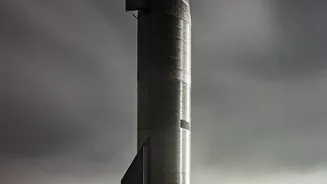





Catching a skyscraper-sized rocket booster with a pair of giant mechanical arms sounds like science fiction. Yet for SpaceX, it's a core engineering strategy for Starship, designed to revolutionize access to space by making rockets fully reusable.
What is the Tower-Catch Strategy?
Instead
of having its Super Heavy booster and Starship upper stage land on legs like the Falcon 9, SpaceX's plan involves both stages flying back to the launch site to be caught in mid-air. The launch tower, nicknamed 'Mechazilla', is equipped with two massive arms, often called 'chopsticks', that are designed to close around the returning rocket and lift it off the ground just before touchdown. This method applies to both the first-stage booster and, eventually, the Starship spacecraft itself. The first successful booster catch occurred on October 13, 2024, proving the concept was viable. The system uses a combination of high-resolution cameras, LiDAR, and powerful actuators to track and safely intercept the descending vehicle.
The Physics of 'Dead Weight'
In rocketry, every kilogram counts. To reach orbit, a rocket must overcome Earth's gravity, and any mass that isn't propellant or payload is effectively 'dead weight' that reduces efficiency. Traditional landing legs, while essential for a conventional landing, are heavy pieces of hardware that serve no purpose during ascent. For a vehicle as large as Starship, a robust set of landing legs could weigh between 5 and 10 metric tons. By removing them entirely, SpaceX can subtract that significant mass from the vehicle's total 'dry mass'—the weight of the rocket without fuel.
More Payload, More Possibilities
The weight saved by removing the legs translates directly into increased payload capacity. Less dead weight means the rocket can carry more cargo to orbit for the same amount of fuel. While Starship is already designed to lift over 100 metric tons to low Earth orbit, eliminating the legs could boost its payload capacity by a significant margin, potentially 10-15%. This enhancement is crucial for SpaceX's business model. It allows them to launch more of their own next-generation Starlink satellites per flight or offer more competitive pricing and capacity for commercial and government missions, including NASA's Artemis program to return to the Moon.
The Need for Speed: Rapid Reusability
Beyond payload, the tower-catch system is fundamental to achieving rapid reusability. Catching a booster with the tower arms allows SpaceX to immediately place it back onto the launch mount for inspection and preparation for its next flight. This process eliminates the time-consuming logistics of landing a rocket on a separate pad or droneship, transporting it horizontally, and then craning it back onto the launch mount. The ultimate goal is to enable an airline-like operational tempo, with the potential for multiple launches per day from the same pad, a key factor in making interplanetary travel economically feasible.
An Immense but Calculated Risk
The tower-catch maneuver is an incredibly complex and high-stakes operation. The margin for error is razor-thin; the returning rocket must navigate to a precise point in space with near-perfect velocity and orientation. A failure could be catastrophic, potentially destroying not only the multi-million dollar rocket but also the vital launch tower infrastructure. However, SpaceX is betting that the long-term rewards—unprecedented payload capacity and launch cadence—outweigh the immense engineering challenges. The company continues to refine the process with each test flight, viewing the risk as a necessary step toward achieving a fully reusable space transportation system.