



Defining Our Terms: Day vs. Year
First, let's get our cosmic clocks straight. For any planet, a 'year' is the time it takes to complete one full orbit around its star. Here on Earth, that’s roughly 365 days. A 'day' is the time it takes for the planet to complete one full rotation on its own
axis. For us, that’s about 24 hours. We take this relationship for granted: we experience hundreds of sunrises and sunsets within a single year. This simple rhythm governs our lives, our seasons, and our biology. But the universe has no obligation to follow our terrestrial logic. In the cosmic neighbourhood, Earth's neat and tidy schedule is just one way of doing things, and Venus proves that dramatically.
Venus by the Numbers
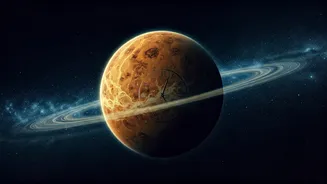
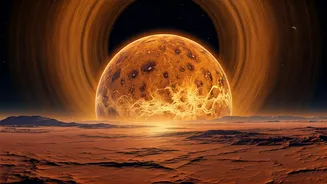
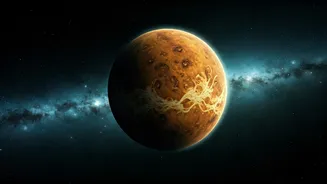
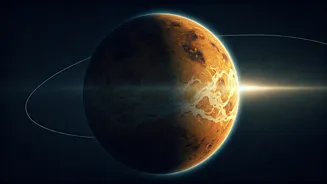
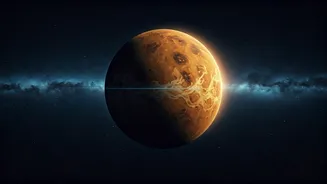
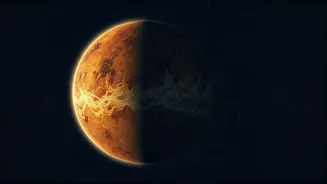
Venus orbits the Sun relatively quickly, completing a full 'year' in just about 225 Earth days. So, if you were born on Venus, you'd celebrate your first birthday after only 225 Earth days had passed. Here’s where it gets truly bizarre. Venus rotates on its axis incredibly slowly. One full rotation—known as a sidereal day—takes approximately 243 Earth days. That’s right: its spin takes longer than its orbit. This is the core of the headline’s claim: a 243-Earth-day rotation is longer than a 225-Earth-day year. To make things even stranger, Venus spins backwards compared to Earth and most other planets in our solar system. This is called retrograde rotation. So, if you could stand on the Venusian surface, you would see the Sun rise in the west and set in the east. Because of this backward spin, the time from one sunrise to the next (a solar day) is different from its rotational period, clocking in at about 117 Earth days. It’s still an incredibly long day, but it’s the 243-day sidereal spin that officially outlasts the Venusian year.
Why Is Venus So Weird?
Scientists don't have a single, confirmed answer for Venus's strange behaviour, but they have some compelling theories. One leading hypothesis suggests that early in its history, Venus was struck by a massive asteroid or another planet-sized object. Such a cataclysmic impact could have dramatically slowed its original rotation and even flipped its axis, causing it to spin in the opposite direction. A more recent theory points to Venus's incredibly thick, heavy atmosphere. The planet's atmosphere is about 90 times denser than Earth's, creating immense surface pressure. This dense, fast-moving atmosphere may have created powerful tidal forces over billions of years. These atmospheric tides could have acted like a brake, gradually slowing the planet's spin to its current, leisurely pace. It's possible that a combination of an ancient impact and long-term atmospheric friction worked together to create the oddball planet we see today.
A Day in the Life on Venus
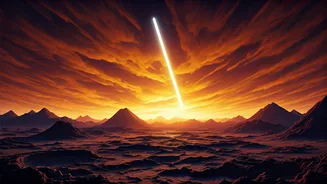
Imagining a day on Venus is the stuff of science fiction nightmares. The planet is a runaway greenhouse effect in action. Its thick clouds are made of sulfuric acid, and the surface temperature hovers around a scorching 465°C—hot enough to melt lead. The atmospheric pressure is equivalent to being 900 metres deep in Earth's ocean. In this hostile environment, the Sun would appear as a dim, hazy glow through the dense clouds. It would rise slowly in the west and take nearly two Earth months to crawl across the sky before setting in the east. Then would come an equally long night of crushing darkness and relentless heat. The slow-motion cycle of a Venusian day is a stark reminder of the planet's extreme and inhospitable nature, a 'hellscape' where our familiar concepts of time and survival completely break down.