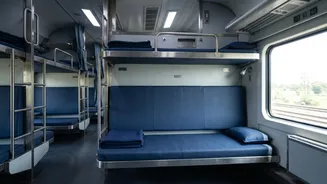







Securing a lower berth on a long train journey is a priority for many, especially senior citizens and those with mobility concerns. While IRCTC's automated system makes the final call, here are four crucial checks you can make before booking.
Correctly Enter Passenger Details
This is the
single most important step. Indian Railways has an automatic lower berth quota system for certain passengers. This priority is given to male senior citizens aged 60 and above, and female passengers aged 45 and above. The system can only identify eligible passengers if their age and gender are entered accurately during booking. Any mistake in these details means the system will not automatically consider you for the reserved lower berth quota. This quota earmarks a specific number of lower berths in most Sleeper and AC coaches—typically four to seven in Sleeper Class, four to five in 3AC, and three to four in 2AC. By ensuring the age is correct, you allow the algorithm to do its job and check for an available quota berth first. This happens automatically, even if you don't select a preference, but it's always best to be precise.
Use the Berth Preference Option
While entering passenger details, you will see a 'Berth Preference' dropdown menu for each person. Your options are typically Lower, Middle, Upper, Side Lower, and Side Upper. Actively selecting 'Lower' here is a direct instruction to the IRCTC booking algorithm. While it is not a guarantee—as allocation depends on real-time availability and quotas—failing to select a preference leaves the decision entirely to the system. Setting this preference tells the reservation system your desired outcome. For any passenger who does not qualify for the automatic senior citizen quota, this is the primary way to influence the seat allocation. For the best results, book your tickets as soon as the advance reservation period opens, as there are more unallocated seats available, giving the preference logic more options to work with.
Understand the 'Reservation Choice' Checkbox
Towards the bottom of the booking page, IRCTC provides 'Reservation Choice' options that can be a powerful tool. One of the most useful settings here is 'Book, only if at least 1 lower berth is allotted'. If you select this checkbox, the system will only proceed with the booking if it can confirm at least one lower berth for the passengers on that ticket. If no lower berth is available at that moment, the transaction will fail, and your money will not be deducted. This is an excellent failsafe for those for whom a lower berth is non-negotiable. Be aware, however, that using this option on a busy route might mean you don't get a ticket at all if the lower berths are already taken. It's a trade-off between getting a ticket and getting the right ticket.
Mind the Group Booking Rules
How you group passengers on a single ticket (PNR) significantly impacts the lower berth quota. The automatic quota for senior citizens generally applies only when one or a maximum of two eligible passengers are travelling on the same PNR. If you book a ticket for an eligible senior citizen along with a younger, non-eligible passenger, the system may default to the general quota, ignoring the lower berth priority. This is a common reason why eligible travellers miss out on a lower berth. If securing a lower berth for an elderly parent or relative is the top priority, consider booking their ticket on a separate PNR. While this might mean you aren't seated in the exact same cabin, it greatly increases the chances of the automated lower berth quota being successfully applied.