


Meet NASA's New Cosmic Surveyor
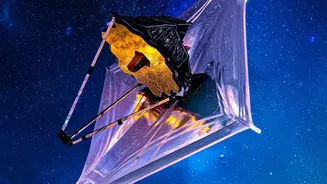
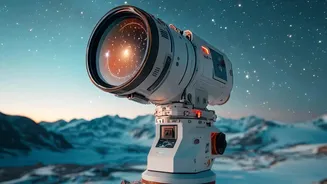
The Nancy Grace Roman Space Telescope is a NASA flagship mission designed to tackle some of the biggest questions in astrophysics. Named after NASA's first chief of astronomy, Nancy Grace Roman, this observatory is not just an incremental upgrade; it
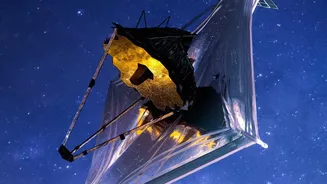
represents a new way of doing astronomy. While the James Webb Space Telescope (JWST) is designed for deep, narrow dives into specific cosmic targets, Roman is built for speed and scale. It possesses a 2.4-meter primary mirror—the same diameter as the Hubble Space Telescope's—but its primary instrument, the Wide Field Instrument (WFI), gives it a truly panoramic perspective. Its main goals are to investigate the perplexing mysteries of dark energy and dark matter, and to conduct a massive census of planets outside our solar system, known as exoplanets.
A Panoramic Window on the Universe
So what is this wide field of view? Imagine looking at the night sky through a drinking straw. That's a simplified way to think about the view from many powerful telescopes like Hubble and Webb, which excel at capturing extreme detail in a tiny patch of sky. Now, imagine replacing that straw with a giant panoramic window. That's the Roman Space Telescope. Its Wide Field Instrument can capture an area of the sky at least 100 times larger than Hubble's infrared camera in a single snapshot, all while maintaining a similar, Hubble-like sharpness. An observation that might have taken Hubble months or even years to piece together, Roman can complete in a matter of days. This incredible efficiency will allow Roman to map huge portions of the universe, creating the largest, deepest cosmic maps ever assembled.
Solving the Dark Mysteries
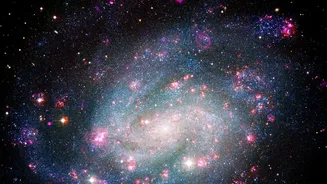
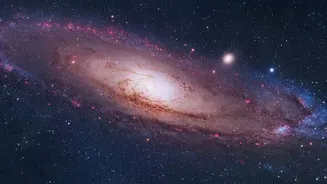
About 95% of the universe is made of dark energy and dark matter, enigmatic components we cannot see or directly detect. Scientists know they dominate the cosmos because of their gravitational effects, but their fundamental nature remains unknown. Roman is designed to attack this problem head-on. By surveying over a billion galaxies, Roman will create vast 3D maps of the universe's structure. Astronomers will use these maps to study how dark matter, the invisible scaffolding of the cosmos, has clumped together over billions of years. They will also track the history of cosmic expansion by observing thousands of distant supernovae. This will help determine if dark energy, the force driving the universe's accelerating expansion, has changed over time.
A Planet-Hunting Powerhouse
Beyond cosmology, Roman's wide-angle view makes it an unparalleled planet hunter. Instead of staring at one star at a time, Roman will monitor hundreds of millions of stars toward the dense center of our Milky Way galaxy. It will use a technique called gravitational microlensing, where the gravity of a foreground star and its planets bends and magnifies the light from a more distant, background star. These brief brightening events can reveal the presence of planets, even those that are small or far from their star. This survey is expected to find thousands of new exoplanets, from gas giants to rocky worlds, including a new class of 'rogue' planets that wander through space without a host star. This massive statistical sample will give us the most complete census of planetary systems in our galaxy.
A New Era of Cosmic Discovery
Roman is not a replacement for Hubble or Webb, but a powerful complement. By rapidly scanning the sky, it will identify the most interesting and unusual objects—cosmic needles in a vast haystack—that Hubble and Webb can then study in greater detail. Its ability to generate about 1.4 terabytes of data every single day marks a move into the era of big-data astronomy, requiring AI and machine learning to help process the flood of information. The telescope's combination of panoramic view and sharp resolution will enable discoveries across all fields of astrophysics, from finding small objects in our own solar system to studying the most distant supermassive black holes. By seeing the big picture, Roman will give humanity a new atlas of the universe, with no telling what surprises it might find.