


A Cosmic Mystery Uncovered
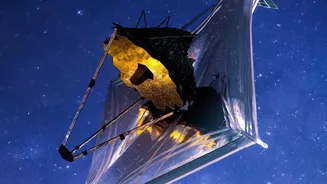
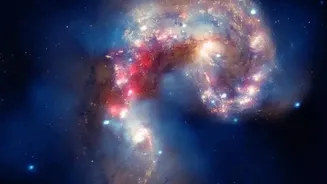
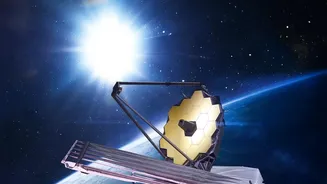
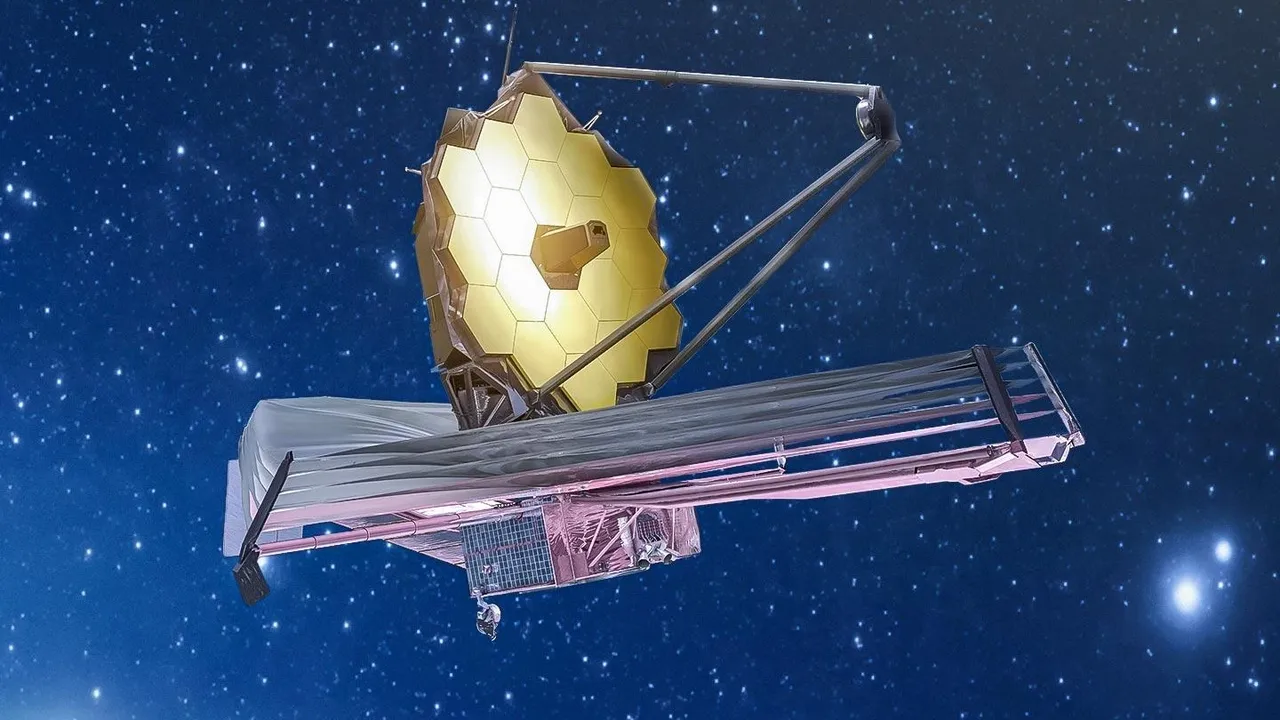
Since it began sending back breathtaking images in 2022, the James Webb Space Telescope (JWST) has been peering into the deepest, earliest corners of the universe. In these images, among the swirling galaxies and distant stars, astronomers noticed something
strange: hundreds of tiny, compact, and distinctly red objects. Nicknamed 'little red dots' (LRDs), these mysterious sources appeared to exist only in the very early universe, around 600 million years after the Big Bang, before seemingly vanishing about a billion years later. Their presence wasn't predicted by existing models, leaving scientists with a fascinating puzzle: what were these enigmatic red specks lighting up the dawn of time?
Were the Models Broken?
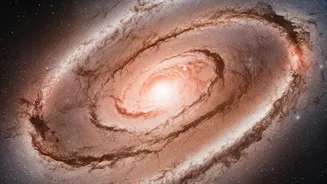
The initial interpretation of these little red dots caused a stir in the astronomical community. One possibility was that they were incredibly massive galaxies. But this presented a huge problem. According to our understanding of cosmology, there simply shouldn't have been enough time or matter for galaxies to grow that large, that quickly, so soon after the Big Bang. This apparent contradiction led to sensational headlines suggesting that these objects were 'universe-breaking' and that our fundamental understanding of cosmology was flawed. If these were indeed galaxies, they were far too developed for their age, like finding a skyscraper in an ancient village. Scientists knew there had to be another explanation.
A New Prime Suspect
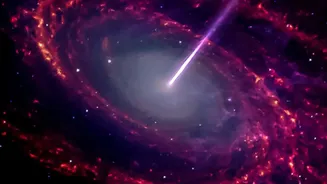
A more compelling theory has since emerged, and it is even more exotic. What if the little red dots aren't galaxies at all, but something else entirely? The leading hypothesis now is that these objects are actively growing, supermassive black holes. This theory suggests we are not seeing the light of billions of stars in a galaxy, but rather the intense glow from a ravenous young black hole, gorging on the gas and dust around it. These objects would be the seeds of the colossal black holes that sit at the centre of most large galaxies today, including our own Milky Way. The JWST wasn't seeing a finished galaxy, but the violent, messy birth of its central engine.
The Telltale Glow
So, why the distinctive red colour? The 'black hole star' model provides a neat answer. According to the theory, these nascent supermassive black holes are shrouded in a thick, dense cocoon of gas and dust. As the black hole furiously pulls in this material, the process generates an immense amount of energy and radiation. This radiation heats the surrounding cocoon, causing it to glow brightly. The dense shroud of dust, however, absorbs the bluer wavelengths of light, allowing only the redder, infrared light to escape and travel across the universe for billions of years until it is detected by Webb's sensitive instruments. We're not seeing the black hole itself, but its glowing, dusty blanket.
The Case of GLIMPSE-17775
The evidence for this theory has become incredibly strong, thanks to recent, detailed observations of a specific little red dot named GLIMPSE-17775. In a stroke of luck, this distant object was magnified by a phenomenon called gravitational lensing, where the gravity of a closer galaxy cluster bent and amplified its light. This gave astronomers an unprecedentedly clear look. The deep spectrum of light captured by JWST revealed over 40 distinct chemical signatures. Multiple, independent lines of evidence from this data all pointed to the same conclusion: this was a supermassive black hole enveloped in a dense cocoon of gas, just as the theory predicted.
Rewriting the First Chapter
This discovery does more than just solve the mystery of some puzzling dots. It helps answer one of the biggest questions in modern astronomy: how did supermassive black holes get so big, so fast? Finding these 'black hole stars' is like finding the missing link between the early universe and the vast galaxies we see today. They represent a key phase of cosmic evolution, a short-lived but crucial growth spurt for black holes. The headline's witty phrase about 'extreme distance' is spot on—astronomers needed to look at the most distant objects in the universe to understand that not every red light is a galaxy. Sometimes, it is a monster in the making.