




A New Eye on the Cosmos
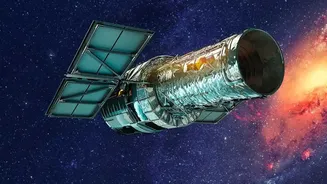
Named after Nancy Grace Roman, NASA's first chief of astronomy and the “Mother of Hubble,” the Roman Space Telescope is a flagship mission on the same scale as Hubble and the James Webb Space Telescope (JWST). Scheduled to lift off aboard a SpaceX Falcon
Heavy rocket on August 30, 2026, it will travel to a stable orbit 1.5 million kilometers from Earth. Unlike its predecessors, Roman’s primary strength isn’t just seeing far, but seeing wide. It features a 2.4-meter mirror, the same size as Hubble's, but its Wide Field Instrument will capture a patch of sky 100 times larger in a single shot. This panoramic view will allow it to map the universe 100 to 1,500 times faster than Hubble could, creating vast cosmic landscapes where rare and fleeting phenomena can be discovered.
The Great Cosmic Census
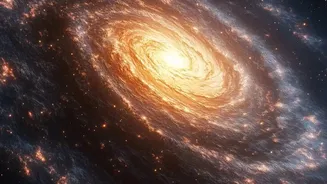
Imagine trying to understand a forest by looking through a keyhole. That has been the challenge for telescopes like Hubble and Webb, which provide incredibly deep but narrow views. Roman, by contrast, throws the doors open. Its primary mission is to conduct massive surveys that will act as a cosmic census. In its five-year primary mission, it is expected to observe over a billion galaxies. This vast dataset is crucial for tackling two of the biggest mysteries in physics: dark energy and dark matter. Dark energy is the mysterious force causing the universe's expansion to accelerate, while dark matter is the unseen substance that holds galaxies together. By mapping the large-scale structure of the universe across cosmic time, Roman will help scientists test their theories about these enigmatic components that make up most of our cosmos.
Hunting for Lonely Planets
One of Roman’s most exciting tasks is to hunt for exoplanets using a technique called gravitational microlensing. This method relies on the effects of gravity on light. When a star or planet passes in front of a more distant star, its gravity acts like a lens, briefly magnifying the background star's light. Roman will stare at the dense starfield at the center of our Milky Way, waiting for these tell-tale flickers. This technique is sensitive enough to find planets as small as Mars and, most intriguingly, planets that are not orbiting a star at all. Scientists theorize that countless 'rogue planets' wander the galaxy alone, and Roman is expected to find hundreds of them, providing our first real census of these lonely worlds. In total, the mission could discover thousands of new exoplanets, dramatically increasing our known catalog of worlds.
Catching Stars in the Act
The universe is dynamic, filled with fleeting events that flare up and fade away. Roman’s ability to repeatedly scan huge areas of the sky makes it an ideal tool for 'time-domain astronomy,' the study of the changing cosmos. It will be on the lookout for cosmic explosions like supernovae, the violent deaths of massive stars. Scientists plan to use Roman to detect around 80,000 of a specific type of supernova that serves as a 'standard candle' to measure cosmic distances with high precision. It will also be a powerful instrument for spotting tidal disruption events (TDEs), which occur when a star gets too close to a supermassive black hole and is torn apart. By detecting TDEs from the early universe, as far back as 11 billion years ago, Roman could help solve the mystery of how supermassive black holes grew so large, so quickly.