






The Old Guard of Forecasting
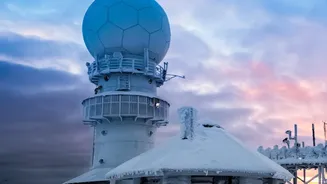
Traditionally, weather prediction has been the domain of giants: massive supercomputers running what are known as Numerical Weather Prediction (NWP) models. These systems operate on the laws of physics, dividing the globe into a grid and solving complex
equations to simulate how the atmosphere will behave. This method has been the gold standard for decades, but it has significant limitations. NWP models are incredibly expensive and require enormous computational power, often taking hours to generate a single 10-day forecast. This immense cost in time and resources means only a handful of wealthy countries can afford to run their own cutting-edge global forecasting systems. The process is akin to building a car engine from scratch every single time you want to drive; it's thorough but slow.
A New Contender Enters: The AI Approach
Artificial intelligence models take a fundamentally different approach. Instead of simulating physics from the ground up, they learn from it. Developers train these AI systems, such as Google's GraphCast and NVIDIA's FourCastNet, on decades of historical weather data. By analyzing 40 years of atmospheric patterns, the AI learns the complex cause-and-effect relationships that govern the weather. It doesn't solve physics equations; it recognizes patterns. This approach allows AI models to generate a full 10-day global forecast in less than a minute on a single specialized computer, a task that takes a traditional supercomputer hours. The result is a system that is not only thousands of times faster but also dramatically more energy-efficient.
Speed, Accuracy, and Early Warnings
The primary benefits of this AI revolution are staggering improvements in speed and accuracy. In head-to-head comparisons, models like Google's GraphCast have outperformed the world's leading traditional model, the European Centre for Medium-Range Weather Forecasts (ECMWF), on over 90% of variables tested. This leap in performance is particularly noticeable in medium-range forecasts (3-10 days out) and in predicting extreme weather. For instance, a publicly available version of GraphCast accurately predicted Hurricane Lee's landfall in Nova Scotia about nine days in advance, several days earlier than traditional models could confidently lock in the location. This ability to provide earlier and more reliable warnings for cyclones, heatwaves, and atmospheric rivers has the potential to save lives and mitigate economic damage.
What This Means for India
The implications for India are profound. The country's agriculture, which employs a significant portion of the workforce, is heavily dependent on the monsoon. AI is already making a tangible impact here. This past summer, 38 million farmers across India received AI-powered forecasts that helped them make critical decisions about when to plant their crops. By integrating AI models like Google's NeuralGCM, forecasters were able to predict the monsoon's onset up to a month in advance with greater accuracy, even capturing unusual dry spells. The Indian Meteorological Department (IMD) has also been leveraging AI to deliver hyperlocal, impact-based weather services, aiming to provide farmers with precise information for sowing, irrigation, and harvesting.
The Future is a Hybrid Model
Despite the impressive performance of AI, experts don't see it as a complete replacement for traditional methods just yet. Instead, the future of forecasting is widely seen as a hybrid approach. AI models excel at pattern recognition and speed, but they can struggle with forecasting extreme events that fall outside their historical training data. Physics-based NWP models, grounded in fundamental laws, provide a crucial backstop and are still superior for certain tasks. Major meteorological centers like the ECMWF and America's NOAA are already integrating AI into their workflows, using it to enhance their existing models. The consensus is that AI will augment, not replace, human meteorologists, freeing them from computational bottlenecks to focus on analysis, communication, and decision support.