


The Challenge of a Martian Diet
A round trip to Mars could take two to three years. Packing enough pre-packaged meals for astronauts is a logistical nightmare due to mass and storage limitations. Furthermore, the nutritional value of stored food degrades over time, which is a significant
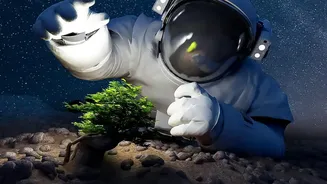
health concern for a crew millions of miles from home. The most viable long-term solution is to grow food on-site. This would not only provide essential vitamins and fresh produce but also offer psychological benefits, as astronauts on the International Space Station (ISS) have reported. However, farming on Mars presents a set of challenges unlike any on Earth.
Why Mars is a Tough Place to Farm
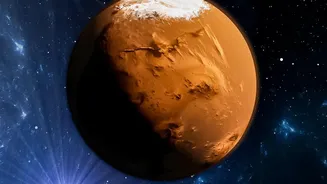
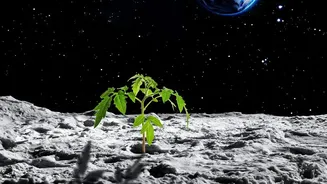
The Red Planet is fundamentally hostile to life as we know it. Its atmosphere is thin, offering little protection from intense solar radiation. Temperatures can swing wildly, from a manageable 35 degrees Celsius to a frigid -90 degrees Celsius. But the biggest hurdle lies in the ground itself. What we call Martian 'soil' is technically regolith, a lifeless mix of rock and dust that lacks the organic matter and beneficial microbes found in Earth's soil. More critically, Martian regolith is laced with toxic perchlorate salts, which are harmful to both plants and humans. Any agricultural system must overcome these environmental and chemical barriers.
A Greenhouse Oasis on the Red Planet
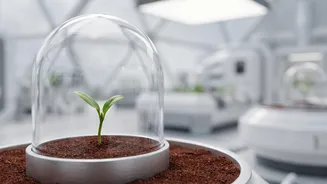
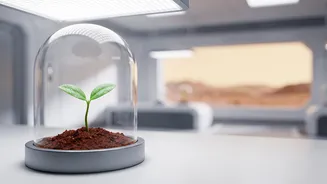
The solution is to create a self-contained artificial environment: a greenhouse. These structures would be sealed, pressurized, and shielded from radiation, possibly by being buried under a layer of Martian regolith. Inside, advanced agricultural techniques would be used. Instead of relying on the toxic native soil, astronauts would likely use soilless methods like hydroponics or aeroponics. Hydroponics involves growing plants in a nutrient-rich water solution, while aeroponics mists the suspended roots directly. Both methods are highly efficient with water and allow for precise control over nutrient delivery, making them ideal for a resource-scarce environment. Advanced LED lighting systems would provide the specific wavelengths of light needed for photosynthesis, compensating for Mars's greater distance from the sun.
What's on the Martian Menu?
Not all crops are created equal when it comes to space farming. Researchers are focusing on plants that are fast-growing, high-yield, nutritious, and require minimal processing. Leafy greens like lettuce and kale, along with radishes, have been successfully grown in experiments using Martian soil simulants. These provide vital nutrients and grow quickly. Tomatoes, peas, and carrots are also promising candidates because they are rich in vitamins that degrade in pre-packaged foods. Scientists at Wageningen University in the Netherlands have successfully grown ten different crops, including tomatoes and rye, in simulated Martian soil, proving a varied diet is possible. While staples like potatoes have been studied, they can struggle in the dense, compacted nature of watered-down regolith.
From Earth Labs to a Greener Mars
The dream of a Martian garden is already taking root in labs on Earth. Projects at the University of Arizona are developing and testing prototype lunar and Martian greenhouses. Researchers are also tackling the soil toxicity problem, with experiments using specific bacteria to break down the harmful perchlorates and add vital organic matter to the regolith. While some studies show that plants can germinate in Martian soil simulant, growth is significantly improved when the soil is treated or amended. These experiments, building on lessons learned from growing plants on the ISS, are creating the foundational technology needed to make off-world agriculture a reality. Each successful harvest in a lab brings humanity one step closer to sustaining itself on another planet.