





The Blueprint for a Breakthrough
To understand why scientists are so excited about space, we first need to look at proteins. These complex molecules are the machinery of life, but when they malfunction, they can cause diseases like cancer, Alzheimer's, or muscular dystrophy. Many modern
drugs work by targeting a specific protein, fitting into it like a key in a lock to correct its function. To design that perfect 'key,' however, scientists first need a flawless 3D blueprint of the 'lock.' This is where protein crystallization comes in. By encouraging a protein to form a highly ordered, repeating crystal lattice, researchers can blast it with X-rays to map its structure down to the individual atom. This process, called X-ray crystallography, is the gold standard for understanding how to design more effective drugs with fewer side effects.
The Trouble with Gravity
On Earth, growing a perfect protein crystal is incredibly difficult for one simple reason: gravity. As crystals begin to form in a solution, gravity causes two problems. First, tiny density differences in the liquid create convection currents, like microscopic eddies in a stream, that buffet the growing crystal and introduce defects. Second, as the crystals become larger, they are heavy enough to sediment, or fall out of the solution, halting their growth. This means that Earth-grown crystals are often too small, too flawed, or too fragile to provide the high-resolution data needed for cutting-edge drug design. For years, this has been a significant bottleneck, slowing down the development of new medicines for countless diseases.
The Zero-Gravity Advantage
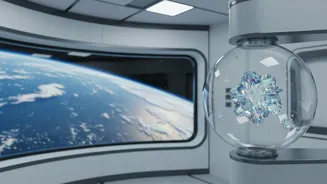
In the microgravity environment of the International Space Station (ISS), these Earth-bound problems vanish. With no significant gravitational pull, convection currents disappear and sedimentation stops. Molecules can assemble themselves into a crystal lattice through a slow, gentle process called diffusion. This stable, undisturbed environment allows protein crystals to grow much larger and with a more perfect, uniform structure than is possible on the ground. Studies have shown that crystals grown in space are of significantly higher quality, allowing scientists to see the protein’s structure in far greater detail. This clearer picture is the crucial element that accelerates drug discovery, enabling researchers to design new molecules with incredible precision.
From Orbiting Lab to Pharmacy Shelf
This is not a futuristic theory; it is happening now. For over two decades, the ISS has served as a unique laboratory for this work, with protein crystal growth being its largest single category of experiments. Pharmaceutical giants like Merck and Eli Lilly have used the station to improve existing drugs and research new ones. For example, experiments on Merck’s blockbuster cancer drug Keytruda sought to grow uniform crystals that could enable its delivery via a simple injection instead of an IV infusion, drastically improving patient convenience. Research on crystals grown in space has also yielded promising leads for treatments for Duchenne Muscular Dystrophy and Parkinson's disease.
The New Commercial Space Race
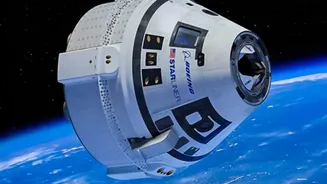
The success of these experiments has ignited a new commercial frontier. While the ISS has been the primary venue, its lifespan is limited. A new wave of private companies is now racing to build commercial space stations and automated orbital platforms. Companies like Varda Space Industries and Axiom Space are developing facilities specifically for in-orbit research and manufacturing, with a major focus on biopharmaceuticals. The goal is to make access to microgravity more frequent, more affordable, and more routine for pharmaceutical companies. This burgeoning orbital economy promises to transform space from a place of exploration into a vital hub for industrial innovation that has a direct impact on human health back on Earth.