



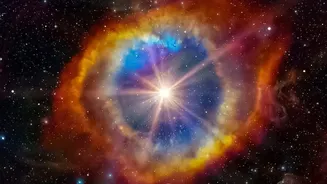
An Old Friend in a New Light
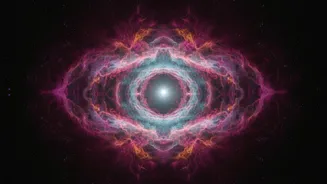
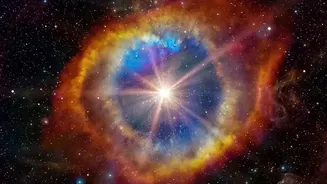
For nearly two centuries, astronomers have admired the Helix Nebula, one of the closest and most striking examples of a planetary nebula. Located about 650 light-years away in the constellation Aquarius, it’s the glowing aftermath of a star, once similar
to our own Sun, that has reached the end of its life. As the star died, it shed its outer layers of gas and dust into space, creating the intricate, ring-like structure we see today. For years, telescopes like Hubble have captured its ethereal beauty, but its ghostly glow concealed many of its deepest secrets. It provides a fascinating, if distant, preview of the eventual fate awaiting our solar system in about five billion years.
Webb's Infrared Superpower
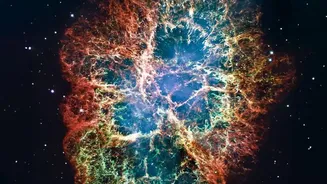
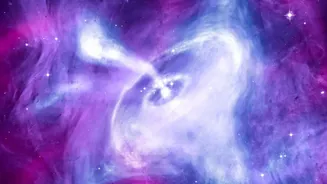
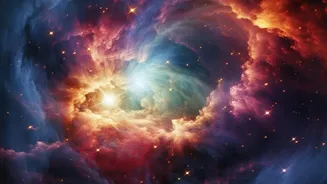
The James Webb Space Telescope sees the universe differently. Instead of just visible light, it specializes in capturing infrared light, which our eyes perceive as heat. This makes it the perfect tool for taking the temperature of the cosmos. When Webb pointed its Near-Infrared Camera (NIRCam) at the Helix Nebula, it didn't just see a beautiful cloud; it saw a complex, dynamic environment where temperature and chemistry are intertwined. The new images use color to represent this thermal data: brilliant blues mark the hottest gas being blasted by intense radiation, yellows show where it has begun to cool, and deep reds trace the coldest regions where dust is forming.
A Clear Line Between Hot and Cold
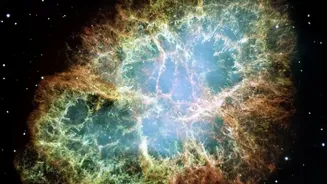
The most stunning revelation is just how sharp the temperature change is inside the nebula. Webb's view shows a stark transition from the intensely hot gas near the central star to the much cooler material farther out. This boundary is a chaotic battleground. Blistering winds of hot gas, moving at high speeds from the dying star's core—a tiny, super-hot white dwarf—are crashing into colder, denser shells of gas that were ejected thousands of years earlier. This collision sculpts the nebula’s most fascinating features: thousands of so-called 'cometary knots.' These are dense clumps of gas and dust, each one larger than our entire solar system, with glowing heads and billion-mile-long tails pointing away from the central star. Webb’s view brings these knots into focus with unprecedented clarity.
A Cosmic Recycling Plant
So, why does this temperature map matter? It reveals in stunning detail how stars recycle their material back into the universe. The intense radiation from the central white dwarf energizes the gas closest to it, but the dense, cool cometary knots act like protective shields. Within these colder, sheltered pockets, hydrogen atoms can join together to form molecules, and dust can take shape. These are the fundamental raw ingredients for future generations of stars and planets. By studying how the hot and cold regions interact, scientists can better understand how the elements forged inside a dying star are distributed into space. In essence, Webb is watching a stellar death scene become a cosmic nursery, providing the building blocks for new worlds yet to be born.