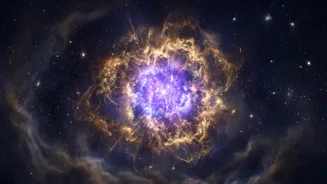


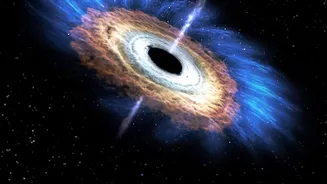


Imagine a cosmic whirlpool of gas and dust spiraling around a black hole. For years, we pictured these accretion disks as relatively stable. New analysis of a decade of data shows they are chaotic, clumpy, and rapidly changing.
What Exactly Are Accretion Disks?
An accretion disk is a vast,
flat, rotating structure made of gas, dust, and plasma that forms around massive celestial objects. Think of water spiraling down a drain—it's the same principle, but on a galactic scale. The immense gravity of a central object, such as a supermassive black hole, a neutron star, or even a newborn star, pulls in surrounding material. However, this material rarely falls straight in. Instead, its momentum causes it to orbit, forming a disk. As the material spirals inward, intense friction and gravitational forces heat it to millions of degrees, causing it to glow brightly across the electromagnetic spectrum, from infrared to powerful X-rays. These disks are the engines that power some of the most luminous objects in the universe, like quasars.
The Challenge of Seeing Chaos
Observing these disks is incredibly difficult. They are located billions of light-years away, making them appear impossibly small from Earth. Until recently, our understanding was based more on theoretical models than direct, detailed observation. For a long time, scientists modeled accretion disks as being relatively smooth and uniform, with matter flowing steadily inward. However, some models predicted significant turbulence and variability. Proving it was another matter entirely. To see the true nature of these structures, astronomers needed to watch them not just for a night, or a month, but for years, and with instruments that could see the invisible light, like X-rays, that they emit so fiercely.
A Decade of Unblinking Eyes
The breakthrough came not from a single observation, but from the painstaking work of combining years of data from a fleet of space-based telescopes. While the headline's 'ten years' points to a general long-term effort, specific studies often rely on extensive archival data. For instance, data from the Event Horizon Telescope (EHT), famous for capturing the first image of a black hole's shadow, revealed that the ring of light around the black hole M87* actually 'wobbles' over time. This wobble is a direct visual cue of the turbulent, dynamic flow of matter in the disk. Similarly, long-term monitoring with X-ray observatories like NASA's Chandra X-ray Observatory and ESA's XMM-Newton has allowed astronomers to track the behavior of these disks in unprecedented detail, moving beyond static snapshots to create a movie of their evolution.
Uncovering Clumps and Warps
What this decade of data exposed is that accretion disks are not smooth rivers of gas; they are lumpy, chaotic, and constantly in flux. Scientists now see evidence of dense 'clumps' of material forming and dissipating within the disk, likely driven by powerful magnetic fields twisting through the churning gas. Recent studies of thermonuclear X-ray bursts from neutron stars have shown that the intense radiation from a burst can dramatically affect the surrounding disk, causing it to warp. These fluctuations and warps are not just minor details—they represent rapid and significant changes in the disk's density and structure. Some theoretical models suggest these changes are driven by a process called the magnetorotational instability (MRI), which creates turbulence and allows material to spiral inward.
Why This Dynamic View Matters
Understanding that these disks are so turbulent changes everything. The way matter flows through a disk determines how fast a black hole 'feeds' and grows. These instabilities and clumps could explain how black holes launch the colossal jets of energy that can influence the evolution of entire galaxies. For protoplanetary disks around young stars, this turbulence is a crucial ingredient in planet formation. It dictates how dust grains collide and stick together, eventually forming planets like Earth. A recent study using data from the Spitzer and James Webb space telescopes on 'debris disks' (a later stage of accretion disks) showed how different types of collisions create different mineral compositions, linking these chaotic processes to the very makeup of future planets.