





The Ultimate Time Machine
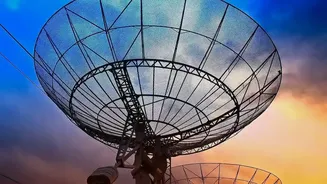
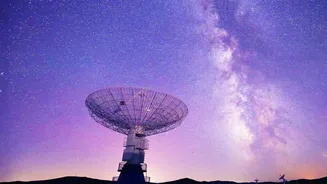
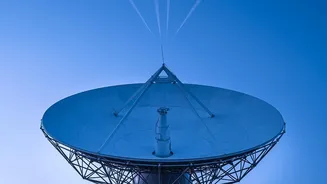
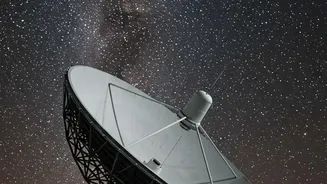
Imagine a telescope so powerful it can see back more than 13 billion years to witness the universe's first sunrise. That is the promise of the Square Kilometre Array (SKA), an international project to build the world's largest and most sensitive radio
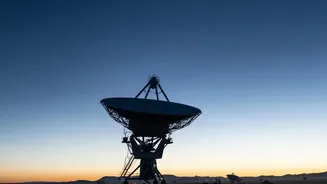
telescope. Spread across two remote desert locations in South Africa and Australia, the SKA isn't a single dish but a vast network of thousands of antennas working together. This global collaboration aims to answer some of the most fundamental questions in science, chief among them being how the first stars and galaxies lit up the cosmos after the Big Bang. Construction began in 2022, and as the telescope arrays gradually come online, astronomers are preparing for a flood of data that will change our picture of the universe forever.
India's Pivotal Role in the Project
This monumental scientific quest has a significant Indian connection. India is a full member of the SKA Observatory (SKAO), contributing both financially and intellectually to the project. The Indian government has approved a contribution of ₹1250 crore, cementing the nation's role as a key player. The effort is led by the National Centre for Radio Astrophysics (NCRA) in Pune, which coordinates a consortium of more than 20 Indian research institutions. Critically, Indian scientists and engineers have led the development of the Telescope Manager, the incredibly complex software that will act as the 'central nervous system' for the entire telescope network, making India's contribution indispensable to the SKA's success.
Listening for Whispers of Ancient Hydrogen
So what are these 'faint astronomical waves' the SKA is built to find? They are not sound waves but radio signals, specifically a faint emission known as the '21-centimetre line'. This signal comes from the vast clouds of neutral hydrogen gas that filled the universe during its 'Dark Ages'—a period after the Big Bang but before the first stars ignited. Think of it as the background static of the early cosmos. By tuning into this specific frequency, which has been stretched by the expansion of the universe over billions of years, the SKA can create a 3D map of this primordial hydrogen. This will allow us to see the cosmic web taking shape and pinpoint where the very first structures began to form.
Witnessing the Universe's First Sunrise
The detection of these signals will give us a front-row seat to one of the most transformative periods in cosmic history: the Epoch of Reionization. After hundreds of millions of years of darkness, the first stars and galaxies began to form. Their intense ultraviolet light blazed through the surrounding hydrogen fog, 'reionizing' it by stripping electrons from the hydrogen atoms. This process made the universe transparent to light, allowing it to evolve into the star-filled cosmos we see today. Until now, this era has been largely theoretical. The SKA will provide the first direct images of this 'Cosmic Dawn', showing us the bubbles of ionization expanding from the first light sources and revealing the nature of these mysterious, trailblazing galaxies.
Rewriting Our Cosmic Origin Story
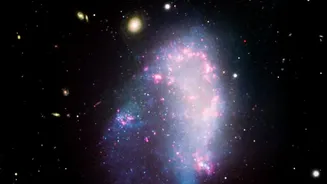
Capturing these signals is more than just an astronomical achievement; it's about completing our own origin story. The data from the SKA will help us understand how the chaotic aftermath of the Big Bang gave way to the ordered structures of stars and galaxies we know today. Scientists will be able to test theories about galaxy evolution, the nature of dark matter and dark energy, and even the fundamental laws of physics under extreme conditions. While other powerful instruments like the James Webb Space Telescope can see the light from very early galaxies, the SKA will map the raw material from which they were born. This complementary view is expected to kickstart a new golden age of astronomy, providing answers to questions we haven't even thought to ask yet.