





A New Generation of Power
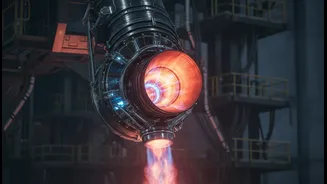
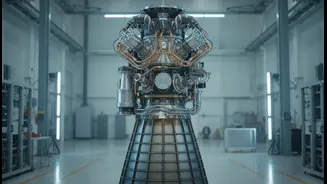
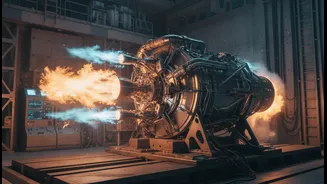
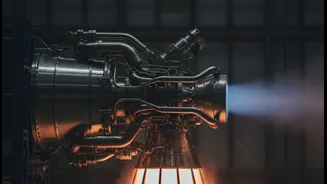
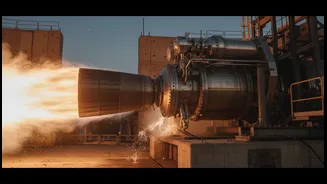
At the heart of this development is the SE2000, a 2000-kilonewton thrust class liquid rocket engine. Recent tests at the ISRO Propulsion Complex in Mahendragiri have demonstrated its core components, known as the powerhead, operating stably at 175 tonnes
of thrust, which is 88% of its full power. This success gives ISRO confidence to proceed with a full-thrust demonstration at 200 tonnes. Unlike fully cryogenic engines that use super-cooled liquid hydrogen and liquid oxygen, a semicryogenic engine uses a combination of liquid oxygen and a refined, rocket-grade kerosene called Isrosene. This seemingly small change has massive implications for performance, cost, and operational efficiency.
The Science of Greater Thrust
The key advantage of the semicryogenic design lies in its fuel. Kerosene is much denser than liquid hydrogen, meaning more fuel can be packed into a smaller tank. This reduces the rocket's overall structural weight. Furthermore, kerosene can be stored at normal ambient temperatures, whereas liquid hydrogen must be kept at a frigid -253 degrees Celsius. This eliminates the need for bulky, heavy, and complex insulation systems, simplifying handling and reducing costs. The engine operates on an efficient oxidiser-rich staged combustion cycle, which allows it to generate immense thrust, making it significantly more powerful than the existing liquid-fuel engines used by ISRO. This technology is complex and possessed by only a few space-faring nations, placing India in an elite group.
Upgrading India's Workhorse Rocket
The immediate application for this new engine is a major upgrade to India's most powerful rocket, the Launch Vehicle Mark-3 (LVM3). ISRO plans to replace the LVM3's current core liquid stage, the L110 which is powered by two Vikas engines, with a new semicryogenic stage (the SC120) powered by a single SE2000 engine. Even a single SE2000 engine will produce more thrust than the two engines it replaces. This strategic upgrade is a game-changer for the launch vehicle, boosting its strength and efficiency in one go.
Heavier Payloads, Bigger Ambitions
The practical result of this upgrade is a significant increase in the LVM3's payload capacity. With the new semicryogenic stage, the rocket's ability to lift satellites into Geostationary Transfer Orbit (GTO) will increase from 4 tonnes to 5 tonnes. This is crucial for launching heavier communication satellites, for which India often relies on foreign launch providers. The capacity to Low Earth Orbit (LEO) will also see a substantial jump from 8 tonnes to 10 tonnes. This enhanced lifting capability is essential for India's future ambitions, including deploying modules for a future Indian space station and enabling more complex deep-space missions.
Gaining a Competitive Edge
Mastering semicryogenic technology is not just about raw power; it's a strategic move to enhance India's position in the global launch market. Currently, India holds about 2% of this lucrative market, with ambitions to increase its share to around 10% by 2030. The SE2000 engine is a key enabler for this goal. By using a more cost-effective and easier-to-handle fuel, ISRO can make its launch process simpler, faster, and cheaper. This will make the LVM3 more competitive commercially, allowing India to launch its own heavy satellites and attract more international customers, strengthening the nation's self-reliance in space access.