



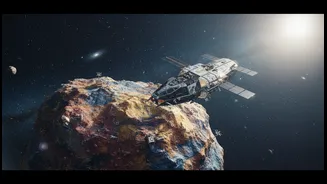


A High-Speed Celestial Encounter
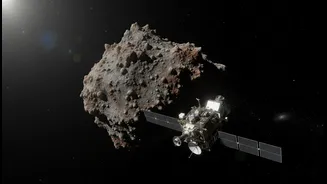
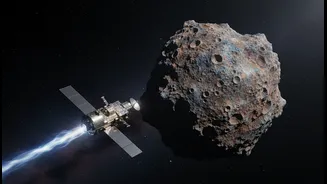
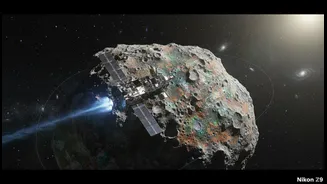
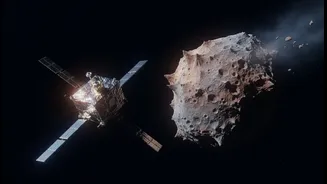
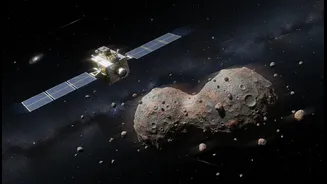
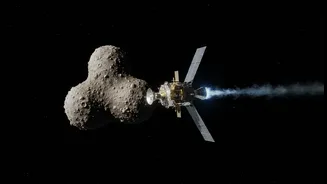
On July 5, 2026, the Japan Aerospace Exploration Agency (JAXA) confirmed its Hayabusa2 probe successfully sped past the asteroid officially known as (98943) Torifune. This wasn't a leisurely visit; the spacecraft zipped by at a relative speed of about
5 kilometers per second. Having already completed its primary mission of collecting and returning samples from the asteroid Ryugu in 2020, Hayabusa2 is now in an extended mission phase. This flyby was the first major test of that new journey. The goal was to get as close as possible to the 450-meter-wide, stony asteroid to gather data without colliding. In the days leading up to the encounter, the spacecraft used its own optical cameras to refine its path, making last-minute adjustments to thread a cosmic needle hundreds of millions of kilometers from Earth.
What the Flyby Accomplishes
This maneuver is a significant demonstration of several key technologies. First, it proves the longevity and reliability of a spacecraft system operating for over a decade. Second, it's a critical test of high-speed flyby techniques for a craft that was originally designed for hovering and landing. The team at JAXA successfully guided the probe to a precise point in space to observe a small, dark object that was only visible a few days before the encounter. This “optical-radio hybrid navigation” is a crucial skill. Furthermore, the flyby serves as a valuable dry run for planetary defense. Should a hazardous asteroid be detected with little warning, the first step would be to launch a reconnaissance probe for a rapid assessment. This mission tests the autonomous software and tracking capabilities needed for such a scenario, where there is no time for human intervention.
The Limits of a Flyby
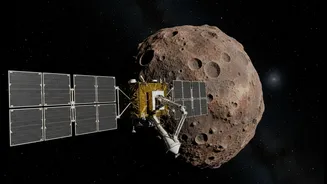
For all its success, the Torifune flyby has inherent limitations and doesn't represent the final word on precision navigation. A key point is that this was a pre-planned trajectory. While there were autonomous, last-minute course corrections, the overall path was plotted from Earth. The mission doesn't test true, long-range autonomous navigation where a spacecraft makes its own decisions over weeks or months without ground control. The spacecraft's instruments were also not optimized for a high-speed pass, limiting observations after the closest approach. Most importantly, a flyby cannot prove the technologies needed for the most complex operations: landing and surface interaction. The original Hayabusa2 mission to Ryugu involved incredibly complex autonomous sequences for descent, hazard avoidance in an unknown rocky environment, and pinpoint touchdowns using dropped target markers—skills this flyby did not require. The craft’s ability to land on an unprepared surface wasn't tested here.
The Unanswered Navigation Questions
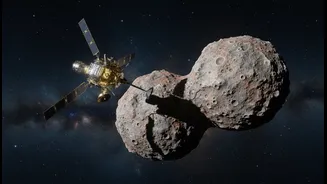
The Torifune encounter highlights the next set of challenges in deep-space navigation. It doesn’t solve the problem of navigating in real-time through a debris field or a system with multiple small bodies, where the environment is unpredictable. It also relies heavily on the Deep Space Network of antennas on Earth for communication and primary orbit determination. Future missions, especially those venturing to the outer solar system, will need greater autonomy to navigate without this constant lifeline, making decisions based on the starfield and nearby objects alone. While Hayabusa2's flyby is a test of its optical guidance, it’s a focused test on a single, albeit fast-moving, target. It does not validate the ability to rendezvous with and orbit an object as small and fast-rotating as its ultimate target, 1998 KY26, which will require an entirely different level of autonomous control upon arrival in 2031.