
The Sun's Unseen Temper
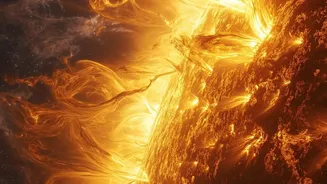
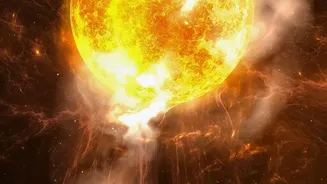
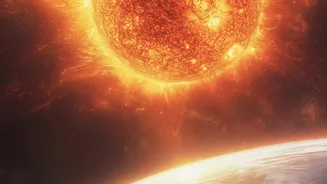
Space weather refers to the changing conditions in space, driven by the Sun's activity. While Earth's magnetic field protects us from the most harmful effects, our technological infrastructure is not immune. The main culprits are solar flares and coronal
mass ejections (CMEs). A solar flare is an intense burst of radiation that reaches Earth in about eight minutes, capable of causing radio blackouts. CMEs are much larger; they are giant clouds of solar plasma and magnetic fields that travel through space and can trigger geomagnetic storms on Earth if they are in our path. These storms, which can take several days to arrive, are the primary cause of major disruptions to our technology.
Satellites in the Firing Line
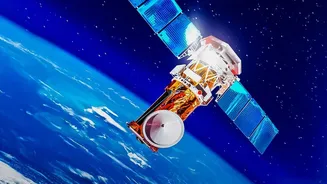
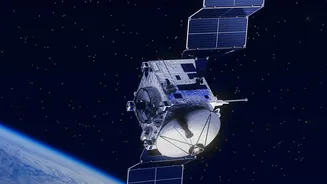
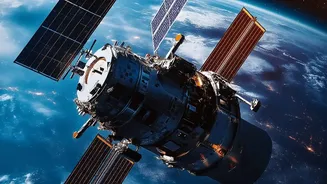
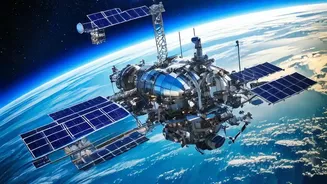
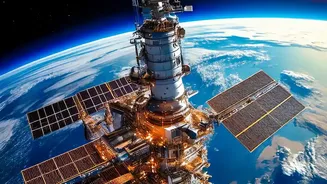
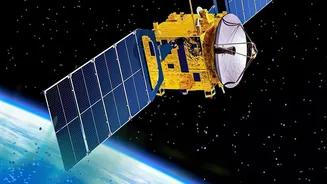
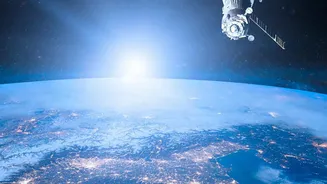
For the thousands of satellites orbiting Earth, a severe solar storm is a multi-pronged threat. The high-energy particles released during a storm can damage or destroy sensitive electronics and degrade solar panels, shortening a satellite's lifespan. Another significant risk, especially for those in low-Earth orbit (LEO), is atmospheric drag. Geomagnetic storms heat and expand Earth's upper atmosphere. This increased density acts like a brake, slowing satellites down and causing them to lose altitude. In a severe event, this can cause satellites to re-enter the atmosphere prematurely. This phenomenon famously caused the loss of dozens of Starlink satellites in 2022. Furthermore, these storms can disrupt the GPS signals we rely on for everything from aviation to farming, causing errors or complete signal loss.
A Jolt to Terrestrial Grids
On the ground, the biggest concern is the electrical power grid. Geomagnetic storms induce powerful, low-frequency electrical currents in the Earth's crust, known as geomagnetically induced currents (GICs). These currents can flow into long conductors like transmission lines and pipelines. Power transformers, which are designed for alternating current (AC), are particularly vulnerable. When GICs, which act like direct current (DC), flow into them, they can overheat, sustain permanent damage, and cause widespread blackouts. Historical events like the 1989 storm that knocked out power across Quebec, Canada, demonstrated just how damaging these solar events can be, even when they are not as powerful as the historic Carrington Event of 1859.
The Early Warning System
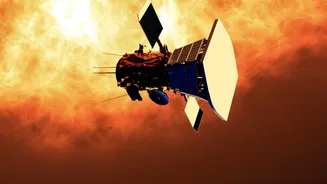
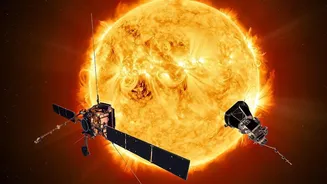
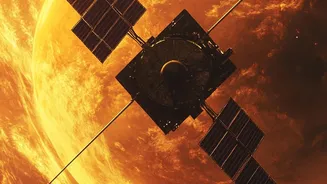
To counter these threats, a global network of observatories constantly monitors the Sun. Agencies like the U.S. National Oceanic and Atmospheric Administration's Space Weather Prediction Center (SWPC) and the Indian Space Research Organisation (ISRO) are at the forefront of this effort. Spacecraft like the Deep Space Climate Observatory (DSCOVR) and India's Aditya-L1 are positioned at a special vantage point 1.5 million kilometres from Earth, acting as space-based buoys. They detect the solar wind and CMEs heading our way, providing crucial advance notice—from minutes for radiation bursts to days for geomagnetic storms. Forecasters analyze this data 24/7 to issue a series of watches, warnings, and alerts, much like terrestrial weather forecasting, to notify industries and governments of impending space weather.
From Alert to Protective Action
These alerts are not just for informational purposes; they trigger concrete protective measures. Upon receiving a warning, satellite operators can command their spacecraft to enter a protective 'safe mode', powering down sensitive electronics to prevent damage from radiation. They can also plan for potential orbital adjustments to counteract atmospheric drag. For power grid operators, alerts provide time to prepare the system for the impact of GICs. They might reconfigure the grid to redistribute power loads, postpone maintenance, or, in extreme cases, strategically take vulnerable transformers offline to prevent long-term damage. Some utilities are also installing new hardware, like neutral blocking devices, to physically block these damaging currents from entering transformers. These actions form an essential, proactive defence against the Sun's powerful outbursts.