



The Celestial Theatre
There’s a quiet magic to a monsoon night that is unlike any other time of year. After the day’s downpour subsides, the air feels cleansed and the world seems to hold its breath. It is on these nights that the sky puts on its most dramatic performance.
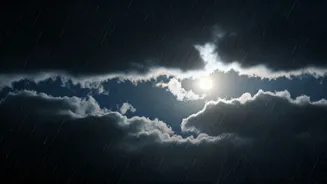
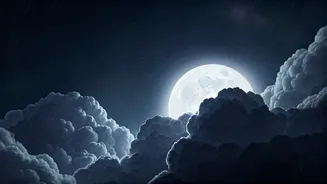
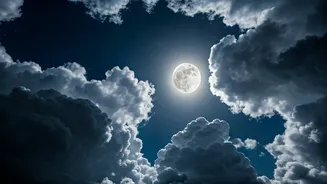
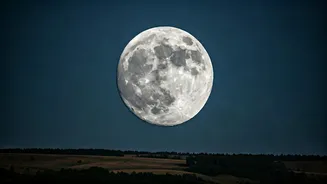
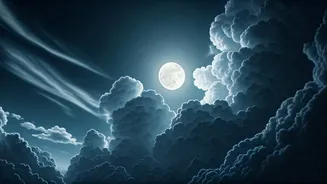
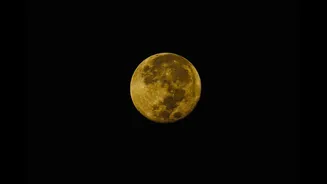
The moon, often playing peek-a-boo, becomes the star performer. Rather than a flat, dark canvas, the sky is a multi-layered stage where clouds of all shapes and sizes drift and swirl. Sometimes, dense, dark clouds almost entirely obscure the moon, leaving only a faint, mysterious glow that outlines their edges in silver. At other times, thin, wispy clouds act as a natural filter, scattering the moonlight to create an ethereal halo or a soft, diffused radiance that bathes the landscape in a dreamlike quality. This interplay of light and shadow is a dynamic spectacle. One moment, the moon is a sharp, brilliant disc against a clearing sky; the next, it is a soft orb veiled by a passing shroud of vapour, its light painting the clouds in shades of grey, white, and silver. This constant movement and transformation lend a sense of life and drama to the otherwise still night, turning a simple glance upwards into a captivating experience.
The Science of the Spectacle
What we perceive as pure drama is rooted in simple physics. Moonlight is merely reflected sunlight, and when it reaches our atmosphere, it interacts with the water droplets and ice crystals that form clouds. The visual effects depend entirely on the type, density, and altitude of the clouds. Thick, low-level rain clouds, heavy with moisture, can block most of the moonlight, creating those stark silhouettes and inky blackouts. However, thinner, higher-altitude clouds, like cirrostratus, are composed of tiny ice crystals that refract the moonlight, often creating a luminous ring or halo around the moon. Sometimes, the light scatters in such a way that it produces a lunar corona, a smaller, more colourful ring directly around the moon. This effect is caused by the diffraction of light by water droplets in the clouds. The overcast skies of the monsoon can also act like a giant softbox, diffusing the moonlight evenly and reducing harsh glare, which can paradoxically make it easier for our eyes to pick out details in the landscape below. The air, often cleared of dust and pollutants by the rain, further enhances visibility, making the light appear crisper and cleaner.
A Muse for Poets and Dreamers
In India, the monsoon is deeply woven into the cultural and spiritual fabric, and its interplay with the moon has not gone unnoticed. For centuries, poets, artists, and musicians have drawn inspiration from these dramatic nights. In classical literature, the monsoon is often a time of longing, romance, and renewal, with the veiled moon serving as a powerful symbol of a lover's hidden face or a beauty that is both present and distant. The season, known as Chaturmas in Hindu mythology, is a period of cosmic significance, and the moon plays a central role in the luni-solar calendar that governs many festivals. The arrival of the rains is celebrated with festivals like Teej, which is associated with fertility and family bonds. The moonlit nights of this season evoke a complex mix of emotions—relief from the summer heat, the joy of nature's rejuvenation, and a contemplative mood that encourages introspection. From the verses of Kalidasa to modern Bollywood songs, the imagery of the rain-washed moon continues to be a recurring motif, representing everything from hope and despair to love and solitude.
How to Best Experience the Show
You don’t need any special equipment to enjoy this celestial display—just a bit of patience and a clear view of the night sky. The best moments often occur just after a heavy spell of rain has passed, when the clouds begin to break apart. Find a spot away from the glare of city lights to allow your eyes to fully adapt to the dark. For those interested in capturing the magic, a bit of cloud cover can actually be beneficial for photography. While clear skies are ideal for crisp astrophotography, the clouds add texture, mood, and a sense of scale to a moonlit landscape. Use a tripod to keep your camera steady for the longer exposures needed in low light. Experiment with your camera's manual settings; a wide aperture and a slightly higher ISO can help capture the faint light. Don't just focus on the moon itself; try to compose a wider shot that includes the landscape—silhouetted trees, glistening rooftops, or reflective puddles—to tell a more complete story of the monsoon night. The goal isn't just to document the moon, but to capture the feeling of being bathed in its dramatic, ever-changing light.