



A Landmark Discovery in a Distant World
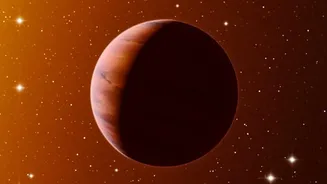
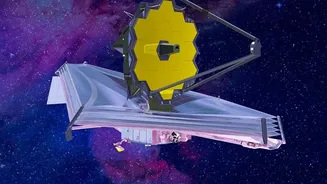
In a historic announcement, scientists have confirmed the presence of water vapour in the atmosphere of an exoplanet, a planet outside our solar system. Using the unparalleled power of the James Webb Space Telescope, researchers have analysed the composition
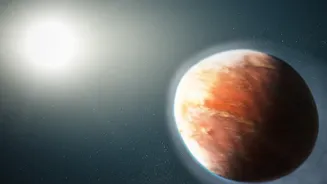
of alien skies with unprecedented detail. While water has been detected in various forms in space before, finding it as a vapour in the atmosphere of a distant world is a monumental achievement. These findings often focus on planets that, while not 'Earth 2.0', provide crucial clues. For instance, recent studies have looked at planets like the 'sub-Neptune' TOI-421 b and rocky worlds like GJ 486 b, both of which have yielded tantalising hints or confirmations of atmospheric water. These discoveries are not just about a single molecule; they represent a new chapter in our ability to probe potentially habitable environments across the galaxy.
How Webb Peered Into an Alien Sky
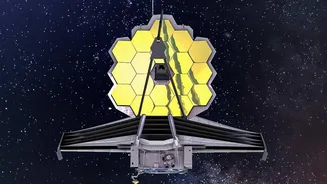
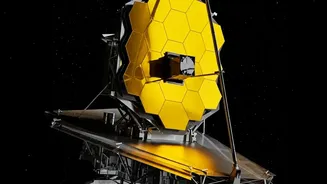
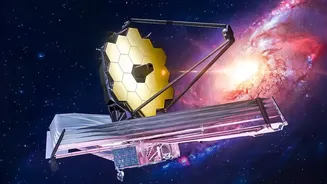
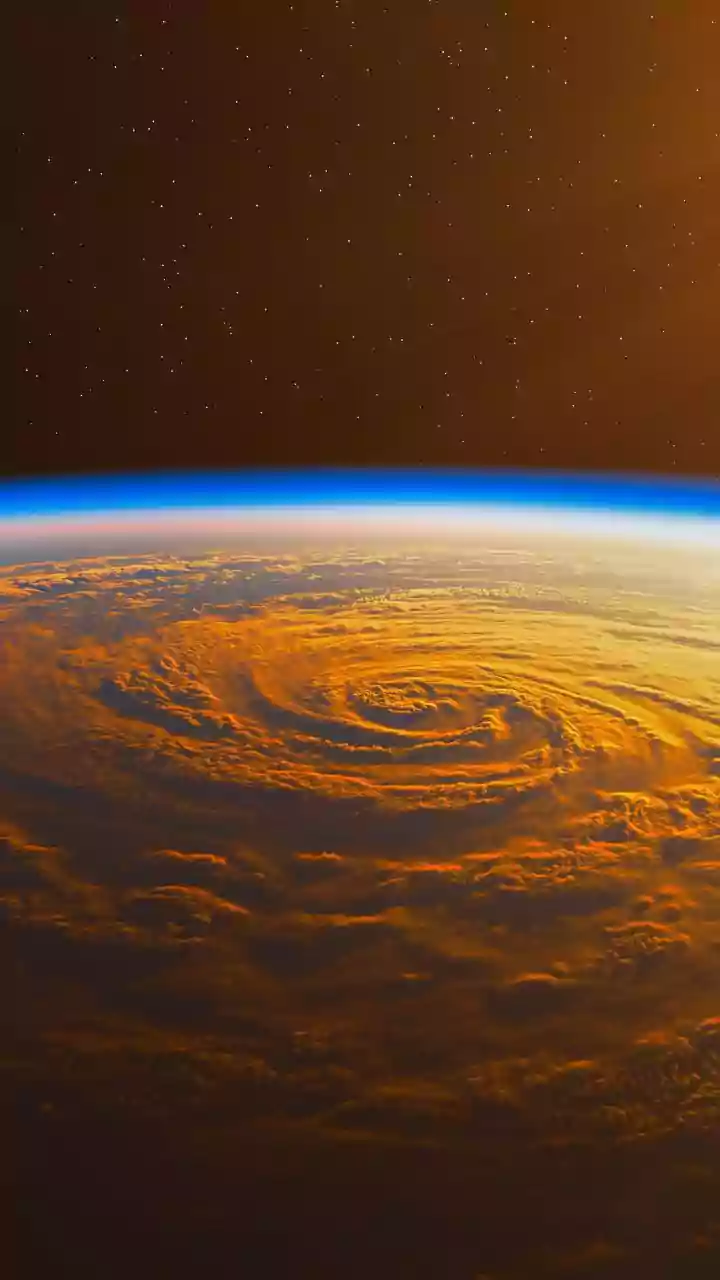
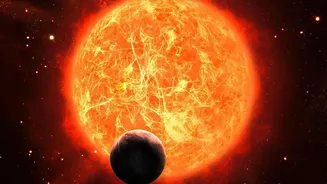
So, how does the JWST accomplish such a feat from millions of kilometres away? The magic lies in its powerful infrared sensors and a technique called transit spectroscopy. When an exoplanet passes in front of its host star from our viewpoint, a tiny fraction of the starlight filters through the planet's atmosphere. The molecules in that atmosphere absorb specific wavelengths of light, leaving a unique chemical fingerprint. The JWST's Mid-Infrared Instrument (MIRI) and Near-Infrared Spectrograph (NIRSpec) are exquisitely sensitive to these fingerprints. They can capture and analyse this filtered light, allowing scientists to identify the chemical components present, including the tell-tale signature of water vapour. It's like analysing the Earth's sunset; the colours tell you about the particles in our own atmosphere. Webb does this for worlds light-years away.
The Crucial Ingredient for Life
The excitement surrounding this discovery boils down to one simple fact: water is essential for life as we know it. On Earth, every living thing requires water to survive. It acts as a universal solvent, facilitating the chemical reactions necessary for biology to function. Finding water vapour in an exoplanet's atmosphere is a critical first step. It suggests that one of the most vital ingredients for life could be present. However, scientists are careful to manage expectations. The presence of water vapour doesn't automatically mean liquid water is on the surface, nor does it confirm the existence of life. Some of these planets are scorching hot, like GJ 9827d, which has a surface temperature comparable to Venus, making it a steamy, inhospitable world. Still, it's the most promising lead we have ever had.
From Vapour to Habitable Zone
The ultimate goal is to find a rocky planet, similar in size to Earth, orbiting within its star's 'habitable zone'. This is the region where temperatures are just right for liquid water to exist on the surface. Discoveries like the one on K2-18b, a planet eight times the mass of Earth, have previously shown water in a habitable-zone exoplanet's atmosphere, though this was detected by the Hubble telescope. The JWST's advanced capabilities allow it to go further, probing the atmospheres of even smaller, rockier worlds. Scientists are now moving beyond just detecting water. They are looking for a whole suite of molecules—like methane, carbon dioxide, and others—that could point towards a dynamic, and possibly biological, planetary system. The detection of methane on WASP-80 b is another piece of this complex puzzle. Each discovery helps refine our models of how planets form and whether the conditions for life are common or rare in the universe.
A New Era for Cosmic Exploration
This confirmation of atmospheric water vapour is more than just a single data point; it's a testament to a new era of astronomical capability. The James Webb Space Telescope is not just finding new planets; it is beginning to characterise them in detail. Before Webb, measurements of this type were incredibly difficult, if not impossible. Now, we are moving from simply cataloguing distant worlds to truly understanding their chemistry and potential for life. This opens up countless new avenues for research, not just for international space agencies but for scientists and institutions around the world, including in India. As we continue to point this incredible infrared eye towards the cosmos, we move closer to answering that fundamental question of our uniqueness in the universe. The search is no longer a matter of pure speculation but of systematic, data-driven science.