




An Anniversary Portrait of a Cosmic Collision
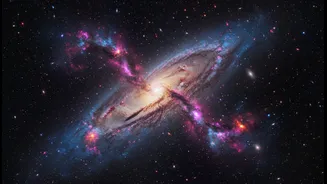
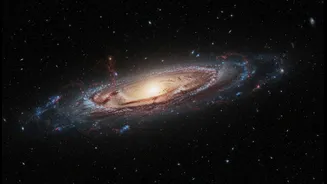
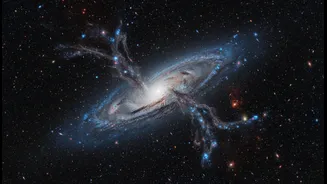
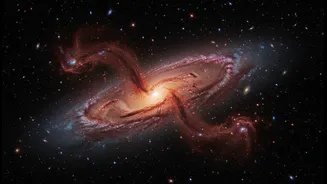
To mark four years of groundbreaking science, NASA and its partners released an astonishingly detailed image of Centaurus A, a massive galaxy about 11 to 13 million light-years away. Unlike many nearby galaxies, Centaurus A is incredibly active. It's
the product of a colossal collision between two galaxies billions of years ago, and the chaotic aftermath is still playing out. At its heart, a supermassive black hole is actively feeding on gas and dust, launching powerful jets of energy that shape the entire galaxy. The new image, a composite from Webb’s Near-Infrared (NIRCam) and Mid-Infrared (MIRI) instruments, cuts through the thick dust that blinded other telescopes like Hubble, revealing the galaxy's turbulent core and millions of individual stars for the first time.
Not a Photograph, but Data Made Visible
Here's the most crucial piece of context: the image isn't a photograph in the way we think of one. The Webb telescope is designed to see the universe in infrared light, which is invisible to the human eye. This allows it to peer through cosmic dust and see objects that are too distant or too cool to glow brightly in visible light. The raw data Webb sends back comes in the form of black-and-white images, each capturing a specific slice of the infrared spectrum. To create the color portraits we see, imaging specialists translate this data into a format our eyes can understand. It's less like taking a picture and more like translating a book from a language you can't read into one you can.
Decoding the Colors
So, if the colors aren't 'real,' what do they mean? They are a scientific tool for visualization, not an artistic choice. Imaging specialists assign visible colors to the different invisible infrared wavelengths. Following a standard convention, the shortest infrared wavelengths are assigned bluer colors, while the longest wavelengths are assigned redder colors, with other shades in between. In the Centaurus A image, this technique reveals different features. The golden-orange dust lanes highlight the raw material for star formation, the hazy glow is resolved into millions of individual stars, and the reddish-purple dots pinpoint stellar nurseries where new stars are being born. This 'false-color' imaging allows scientists—and us—to distinguish between dust, gas, and stars and understand the complex processes at play.
The Science Behind the Spectacle
This contextualized view does more than just look pretty; it unlocks incredible science. By seeing through the dust, astronomers can now conduct 'galactic archaeology,' studying different generations of stars to piece together Centaurus A's violent history. They can trace how the ancient merger triggered bursts of star formation and how the central black hole now regulates the galaxy's growth—sometimes compressing gas to create new stars, and other times blowing it away to halt the process. The unprecedented detail even reveals new mysteries, like a curious S-shaped dust feature near the galaxy's core that scientists are still working to explain.