

A Legacy of Watching the Skies
For decades, the Hubble Space Telescope has served as humanity's patient eye on the cosmos. A key part of its mission is the Outer Planet Atmospheres Legacy (OPAL) program, which involves taking yearly snapshots of our solar system's gas giants. This
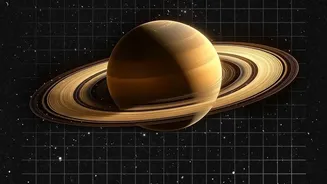
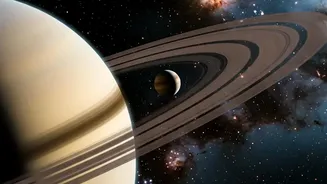
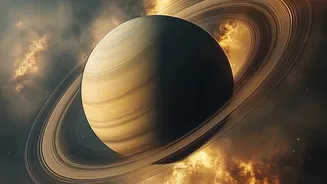
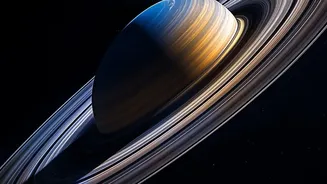
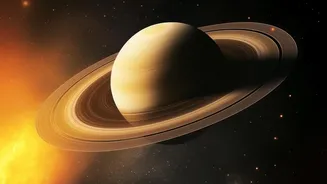
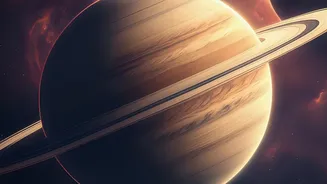
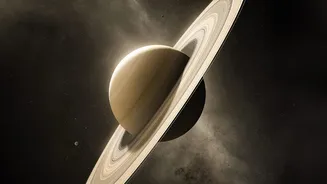
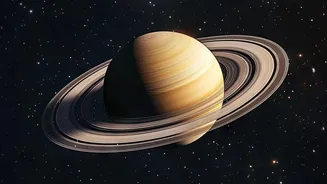
consistent, long-term monitoring allows astronomers to track subtle changes over time, distinguishing fleeting weather from long-term seasonal shifts. A single year on Saturn lasts for about 29 Earth years, meaning each season stretches for roughly seven of our years. The latest data, captured as Saturn’s northern hemisphere moves from summer toward its 2025 equinox, is providing a crucial look at this seasonal transition.
Seeing in a Different Light
While Hubble observes the universe primarily in visible and ultraviolet light, its recent studies of Saturn have been powerfully complemented by the infrared capabilities of the James Webb Space Telescope (JWST). Hubble’s view shows the subtle colour variations in the planet's cloud bands we would see with our eyes. In contrast, infrared light allows scientists to peer through the hazy upper layers and see different depths of the atmosphere. This combined approach lets researchers effectively 'slice' through Saturn’s atmosphere like an onion, creating a three-dimensional picture of how its weather systems work. It reveals the temperature, chemical composition, and cloud structures that are otherwise hidden from view.
The Shifting Bands and Lingering Storms
The new observations have confirmed that Saturn's atmosphere is anything but calm. Data collected between 2018 and 2020 already showed slight year-to-year changes, with the equatorial region brightening and wind patterns subtly altering. A reddish haze observed over the northern hemisphere might be a result of increased heating from summer sunlight, which could be changing atmospheric circulation or the composition of aerosols. More recent infrared views have highlighted a long-lived jet stream meandering across the northern mid-latitudes, and even spotted a lingering remnant of the 'Great Springtime Storm' from over a decade ago. These features showcase how events deep below the visible cloud tops can have lasting effects.
A Last Look at the North Pole
One of Saturn's most mysterious features is the massive, six-sided jet stream at its north pole, known simply as 'the hexagon'. First discovered in the 1980s, this massive weather pattern is wider than Earth. The latest images from both Hubble and Webb managed to capture its faint edges. These observations are particularly timely, as they are likely the last high-resolution views scientists will get of the hexagon until the 2040s. Saturn’s north pole is now tipping into its long winter, a period of 15 years of darkness that will hide the feature from our telescopes. Understanding the forces that maintain such a stable and uniquely shaped storm is a key goal for planetary scientists.
Why It Matters for Understanding Planets
Studying the atmospheric shifts on Saturn does more than just satisfy our curiosity about a neighboring world. It provides a natural laboratory for understanding the physics of gas giants under extreme conditions. By observing how storms form, evolve, and dissipate, and how seasons progress on a planet so different from our own, scientists can refine their models of planetary atmospheres. This knowledge is crucial not only for understanding Jupiter, Uranus, and Neptune, but also for interpreting observations of the thousands of exoplanets discovered orbiting other stars. Each observation from Hubble builds a richer, more complex story of how planets work, turning distant points of light into dynamic, evolving worlds.