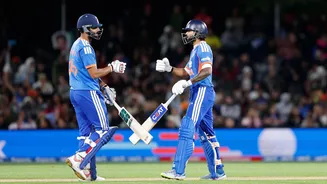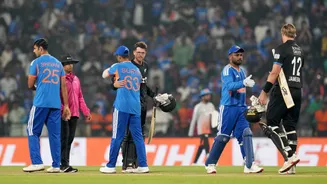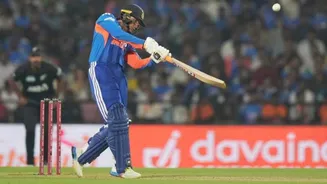

Another day, another Sanju Samson masterclass that sets tongues wagging. His latest half-century against New Zealand was a dazzling display of power and elegance that single-handedly powered a record run-chase. It’s the kind of innings that makes you
believe his time has truly come.
The Numbers Sparking the Debate
When Sanju Samson is in full flow, there are few sights more captivating in world cricket. His recent knock of 67 from just 33 balls against New Zealand in Christchurch is a case in point. It wasn't just the runs; it was the authority with which he dismantled a quality bowling attack, hitting eight fours and four sixes to lay the foundation for India's highest-ever T20I chase. This performance wasn't an isolated event. It follows a T20 series against the West Indies where he was India's second-highest run-scorer, including two fifties. These flashes of brilliance are built on the legacy of his heroic contributions in the 2026 T20 World Cup, where he delivered three consecutive match-winning scores in the knockout stages to clinch the trophy for India. When you look at these peaks, the term 'insane form' from the headlines feels entirely justified.
The Ghost of Inconsistency
For every breathtaking 82 off 41 balls, there seems to be a frustrating single-digit score just around the corner, like the 3 he made in the very next game against the West Indies. This is the central conflict in the story of Sanju Samson. Statistics reveal a pattern that feeds the frustration of fans and critics alike. Since the 2024 T20 World Cup, he has had 18 single-digit dismissals in 40 T20I innings. Even in 2026, a year that has seen him produce incredible highs, his last ten T20I innings before the New Zealand tour averaged just 25.8 despite three half-centuries, highlighting the boom-or-bust nature of his game. Earlier in the year, a brief lean patch in the IPL for his new franchise led to social media debates about his 'intent and hunger'. This constant swing between the sublime and the simple dismissal is why the question 'Has he become Mr. Consistent?' is so difficult to answer with a straight 'yes'.
Why We Can't Stop Talking About Sanju
Despite the rollercoaster form, Samson is perpetually 'never out of conversations'. Why? Because he represents something more than just runs on a scoreboard. He is an idea, a promise of what Indian cricket can look like at its most fearless and graceful. His fan base is immense and fiercely loyal, often arguing that he has been historically underutilised by selectors. This perception of a generational talent waiting for a consistent run has created a powerful narrative around him. Every failure is seen as a tragedy and every success a vindication. Experts also weigh in constantly. Former cricketer Abhishek Nayar noted that 'Sanju plays with everyone's emotions' because just when you begin to doubt him, he produces an innings that makes him undroppable. This emotional investment from millions, combined with his high-impact, aesthetically pleasing style of play, ensures he remains the most talked-about player in the country, regardless of his last score.
Redefining Consistency for a Game-Changer
Perhaps the debate around Samson requires a shift in perspective. Is it fair to judge a high-risk, high-reward player by the traditional metrics of consistency? Former Test batsman Cheteshwar Pujara argued that for top-order T20 players, consistency is 'overrated'. He believes a player like Samson is always just one innings away from being back in form, and his value lies in his ability to change a game in a few overs, not in grinding out 30 runs every match. Team India's current philosophy seems to align with this view. After their 2024 T20 World Cup win, the team has adopted a hyper-aggressive approach, especially in the powerplay. Samson himself has spoken about this, stating the goal is to 'kill the game' early, a strategy that inherently involves risk. In this system, Samson's role isn't to be a consistent anchor but an explosive force. His 'consistency' might be better measured in impact rather than averages.