







A Giant Decagon Appears
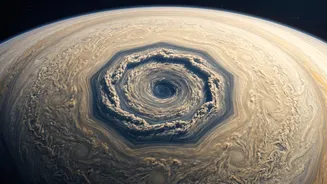
The new feature is an enormous, 10-sided atmospheric wave, often referred to as a 'decagon', encircling Saturn's south pole. This discovery is significant because while scientists have known about a similar, six-sided feature—the famous 'hexagon'—at Saturn's north
pole for over 40 years, the southern pole remained a mystery. The appearance of a decagon suggests that such giant, geometric patterns might be more common on Saturn than previously thought. This newly observed structure is massive, with each of its ten sides stretching over 10,000 miles in length. It's a weather pattern on a scale that is difficult to comprehend, a vast whirlwind in the planet's icy ammonia clouds.
How The Discovery Was Made
The discovery was a joint effort, made possible by NASA's Hubble Space Telescope and diligent observations from astronomers on the ground. For years, Saturn's south pole was tilted away from Earth, hiding it from view. As the planet's seasons changed, the pole gradually tipped back into sight, offering a new window for observation. Scientists with Hubble's Outer Planet Atmospheres Legacy (OPAL) program, which annually monitors the outer planets, pieced together images dating back to 2023. They found faint hints of the structure beginning to emerge, which became a clearly defined pattern in more recent images taken in 2025. The discovery highlights the importance of long-term monitoring, as it provides a rare opportunity to watch a giant atmospheric system develop in real-time.
A Tale of Two Poles
While the new decagon is a sibling to the northern hexagon, it has a distinct personality. The hexagon is famously stable, remaining almost stationary for the four decades it has been observed. The southern decagon, however, appears to be more dynamic and unstable. It migrates eastward at a slow but steady pace, behaving more like a meandering wave than a fixed structure. Furthermore, Hubble's observations at different wavelengths show that the decagon is not just a surface-level cloud pattern. It is a deep, vertically extended structure that penetrates multiple layers of Saturn's atmosphere. This complexity makes it a fascinating subject for scientists trying to understand the forces that shape planetary atmospheres.
A Planet Full of Questions
The sudden appearance of the decagon has left scientists with more questions than answers. Data from NASA's Cassini spacecraft, which orbited Saturn from 2004 to 2017, showed no sign of this long-lived formation. This leads to the most intriguing question: why did it form now? One theory is that its formation may be linked to a nearby anticyclone, a smaller high-pressure vortex, but simulations have not yet been able to fully replicate the decagon. The phenomenon shows just how dynamic and changeable gas giants can be, challenging the perception of them as timeless and unchanging worlds. It serves as a powerful reminder that Saturn still has many secrets to reveal.