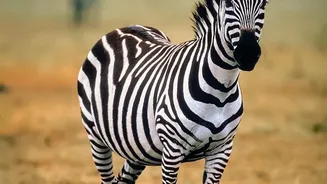



It's one of nature's most iconic designs: the bold, black-and-white coat of a zebra. But far from being a simple uniform, these stripes are as individual as a human fingerprint, a unique natural barcode for every animal.
Nature's Fingerprint
The core fact is as stunning as it
is simple: no two zebras have the same stripe pattern. This uniqueness is a well-established scientific observation. The patterns are formed during the animal's embryonic development through a complex genetic process that controls pigment cells called melanocytes. This results in a permanent, individual pattern that allows researchers, and even other zebras, to tell individuals apart. While the general style of striping can help identify the three different zebra species—plains, Grevy's, and mountain—the specific arrangement on each animal is entirely its own. This personal barcode is so reliable that scientists have developed software to identify and track zebras in the wild just by analysing photos of their flanks.
The Great Stripe Debate
The question of 'why' zebras have stripes has puzzled scientists, including Charles Darwin, for more than a century. Over the years, numerous hypotheses have emerged, with four main theories leading the pack. One of the most popular is pest control. Studies show that biting insects, like tsetse flies and horseflies, are less likely to land on striped surfaces. The patterns seem to confuse the flies' visual systems, providing the zebras with natural protection from bites and the diseases they can carry. Another long-held theory is camouflage. While it seems counterintuitive, the idea is that in a herd, the mass of moving stripes creates a 'motion dazzle' effect, making it difficult for predators like lions to single out one animal to attack. However, some researchers are skeptical, pointing out that lions often hunt at night when stripes are less visible.
Keeping Cool and Connected
A third compelling theory involves thermoregulation, or temperature control. The idea is that the black stripes absorb heat while the white stripes reflect it. This difference in temperature may create small convection currents, or mini-breezes, over the zebra's skin, helping to cool it down in the hot African sun. Some studies have found that zebras in hotter climates tend to have more stripes, lending weight to this idea. Finally, the stripes likely play a social role. Since every pattern is unique, it's believed that stripes help zebras recognise one another. This is especially crucial for a mother and her foal to identify each other, strengthening social bonds that are vital for the herd's cohesion and survival.
A Puzzle Still Unfolding
The process of how these stripes actually form is a fascinating field of developmental biology. During fetal development, a process known as a reaction-diffusion system, first theorised by mathematician Alan Turing, is believed to be at play. This involves chemical signals (an 'activator' and an 'inhibitor') spreading across the skin, creating the distinct pattern of black and white. While scientists have identified genes linked to these patterns, the exact mechanisms are still being unravelled. The prevailing scientific consensus is that the stripes aren't for just one reason. It's likely a combination of factors, where the patterns evolved to provide multiple benefits simultaneously—confusing predators, deterring pests, managing temperature, and helping with social life. This multi-purpose solution makes the zebra's coat a masterclass in evolutionary efficiency.