





An Unpredictable Monsoon
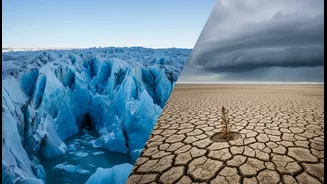
The engine of India’s agriculture and economy, the monsoon, is becoming more erratic, and the melting Arctic is a key reason why. Research from institutions like the National Centre for Polar and Ocean Research reveals a complex link between a warmer
Arctic and India’s rainfall. Less sea ice in the Arctic Ocean changes how heat is distributed across the planet, altering atmospheric currents high above. Recent studies show this can lead to a westward shift in late-season monsoon rains, bringing more intense rainfall to some parts of northern and western India while other regions experience deficits. This unpredictability is a nightmare for farmers who depend on a timely and balanced monsoon, leading to cycles of floods and droughts that threaten food security and rural livelihoods.
The Himalayan Lifeline is Fraying
Closer to home, the Hindu Kush Himalayan region, often called the 'Third Pole', is warming faster than the global average. Glaciers here, which feed great rivers like the Ganges, Indus, and Brahmaputra, are retreating at an unprecedented rate. A recent report from the International Centre for Integrated Mountain Development (ICIMOD) found that the pace of ice loss in the 2010s was 65% faster than in the previous decade. Initially, this rapid melt increases water flow, raising the risk of devastating Glacial Lake Outburst Floods (GLOFs), like the one that hit Sikkim in 2023. However, in the long term, as these glaciers shrink, the dry-season flow of rivers will decrease dramatically. This threatens the water supply for hundreds of millions of people who rely on these rivers for drinking water, irrigation for agriculture, and hydropower.
Our Sinking Shores
The most direct impact of global ice melt is rising sea levels, and for India with its 7,500-kilometer coastline, this is an existential threat. The water doesn't just rise slowly; it surges during storms, leading to more frequent and severe coastal flooding. Major metropolitan hubs like Mumbai, Kolkata, Chennai, and Surat are among the world's most vulnerable cities to sea-level rise. Projections show that large parts of these cities could face annual flooding or even be permanently submerged by mid-century if emissions continue unabated. This puts tens of millions of people, critical infrastructure worth billions, and fragile coastal ecosystems like the Sundarbans at immense risk. The displacement of coastal communities is no longer a future possibility but a current, growing crisis.
An Economic and Social Reckoning
Ultimately, the effects of faraway ice loss translate into tangible economic and social costs for India. Unreliable monsoons and dwindling river flows directly impact agricultural productivity, which forms the backbone of the rural economy. Hydropower generation, a key part of India's energy strategy, becomes less dependable. The cost of protecting coastal cities and relocating vulnerable populations is staggering. Recent partnerships between Indian and international think tanks are now specifically modelling these economic shocks, from disruptions in agriculture to the impact on global trade routes. The conversation is shifting from a purely environmental issue to a core economic and national security concern. The stability that India's economy needs for growth is being directly undermined by changes happening thousands of kilometers away.