


What Exactly Is El Niño?
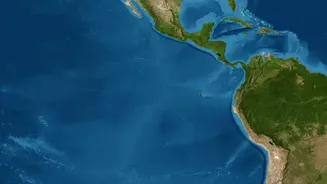
El Niño is a naturally occurring climate phenomenon centered in the tropical Pacific Ocean. Under normal conditions, trade winds blow from east to west, pushing warm surface water towards Asia. During an El Niño event, which happens every two to seven
years, these trade winds weaken or even reverse. This allows a vast expanse of unusually warm water to build up in the central and eastern Pacific Ocean, off the coast of South America. This change in ocean temperature might seem distant, but it sets off a chain reaction in the atmosphere, altering weather patterns on a global scale. The entire cycle, which includes the cold phase (La Niña) and neutral conditions, is known as the El Niño-Southern Oscillation, or ENSO.
The Pacific-Monsoon Connection
The link between a warm Pacific and a dry India lies in large-scale atmospheric circulation. The warming of the Pacific Ocean during an El Niño alters the Walker Circulation, a massive atmospheric loop that governs wind and rainfall patterns. Normally, this circulation helps create favourable conditions for the Indian monsoon. But El Niño disrupts this, creating areas of sinking air over and around the Indian subcontinent. This descending air is dry and stable, which suppresses the formation of rain clouds and weakens the moisture-laden southwest monsoon winds that are crucial for India's rainfall. Historically, this has meant that El Niño years have a strong tendency to be associated with below-average monsoon rainfall and even drought.
Why The Link Isn't Always Perfect
While the correlation is strong, it's not a guarantee. Not every El Niño year results in a drought in India, and some of India's worst droughts have occurred in non-El Niño years. In 1997, for instance, a very strong El Niño was active, yet India received near-normal monsoon rainfall. The reason for this complexity is that other climate factors are also at play. Research suggests that the specific location of the warming in the Pacific matters. Warming concentrated in the central Pacific seems to have a more direct and severe drying effect on India than when it is focused further east. This variability makes forecasting the exact impact a significant challenge for meteorologists.
The Other Big Player: The Indian Ocean Dipole
The Indian monsoon is not just at the mercy of the Pacific. The Indian Ocean has its own climate phenomenon called the Indian Ocean Dipole (IOD), sometimes referred to as the Indian Niño. The IOD relates to the temperature difference between the western and eastern parts of the Indian Ocean. A 'positive' IOD, with warmer waters in the western Indian Ocean (near the Arabian Sea), can boost monsoon rains over India. A 'negative' IOD does the opposite. Crucially, a strong positive IOD can sometimes counteract the negative effects of an El Niño, as was the case in 1997. Therefore, predicting the monsoon's performance requires watching both the Pacific and Indian Oceans.
The 2026 Outlook
As of August 2026, forecasts indicate a strengthening El Niño event is underway. Global agencies like the National Oceanic and Atmospheric Administration (NOAA) have noted a high probability of a 'very strong' or even 'historic' El Niño developing through the fall and winter of 2026-27. For India, the India Meteorological Department (IMD) has forecast below-normal rainfall for August. While the current monsoon is influenced by multiple factors, including low-pressure systems in the Bay of Bengal, the persistence of El Niño remains a significant concern for the latter half of the season. Forecasters are also closely monitoring the IOD, which is currently neutral but expected to turn positive, potentially offering some relief later in the season.
Why It All Matters For India
The performance of the monsoon is deeply intertwined with India's economic and social fabric. About 70-90% of the country's annual rainfall occurs during the monsoon season. A weak or failed monsoon can trigger a cascade of problems: reduced agricultural output, rising food prices and inflation, depleted water levels in reservoirs, and increased demand for electricity to power irrigation pumps. The livelihoods of millions of farmers are directly dependent on these seasonal rains. Understanding the science behind phenomena like El Niño is therefore not just an academic exercise; it's critical for planning, preparedness, and building resilience against climate variability.