

Sailing on Beams of Light
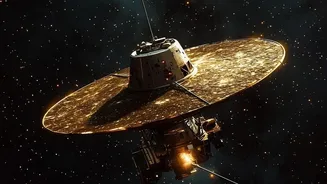
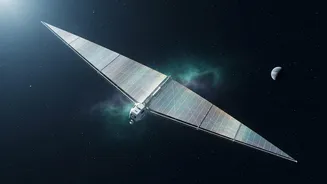
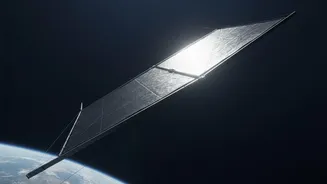
The idea behind a solar sail is beautifully simple. Sunlight is made of particles called photons. While individually they have no mass, they do have momentum. When a photon bounces off a large, reflective surface, it gives that surface a tiny push. In
the frictionless vacuum of space, millions of these tiny pushes can add up to continuous, gradual acceleration. Unlike a chemical rocket that burns through its fuel in minutes, a solar sail can accelerate for years. This eliminates the need for heavy, expensive propellant, which is the single biggest component of a traditional spacecraft's mass. The technology itself is proven; Japan’s IKAROS mission successfully demonstrated a fly-by of Venus in 2010 using a solar sail.
The Heavy Problem of Deep Space
To escape Earth's gravity and travel to other planets, a probe needs a tremendous amount of energy. With conventional rockets, this means carrying massive amounts of fuel. This creates a difficult cycle: more fuel is needed to carry the weight of the fuel itself. This is why reducing a probe's mass is so critical. Every kilogram saved on the spacecraft can save many more kilograms in propellant and reduce the size—and cost—of the launch rocket. For ambitious missions to the outer solar system or even interstellar space, the fuel requirements become almost impossible. A probe propelled by a solar sail, however, launches with its fuel source—the Sun—already waiting for it in space.
New Materials for a New Era
Recent breakthroughs are centered on the sail's two key components: the membrane and the booms that support it. Scientists at NASA are developing advanced materials like graphene-polyimide composites. Graphene, a single layer of carbon atoms, is 200 times stronger than steel but incredibly lightweight. Integrating it into the sail material makes it more durable and resistant to the intense heat and radiation near the sun, which is crucial for slingshot manoeuvres that can fling probes to high speeds. Current materials struggle to operate close to the sun, limiting the maximum achievable velocity. These new composites promise to overcome that barrier.
Lighter, Stronger, Smarter Deployment
The other major innovation lies in the deployable booms that unfurl the sail. Past designs were often either heavy and metallic or bulky. NASA's Advanced Composite Solar Sail System (ACS3) uses new booms made from flexible polymers and carbon fibre. These tube-shaped structures can be squashed flat and rolled up compactly like a tape measure for launch, then unspooled to deploy sails up to 80 square meters. This technology is scalable, with designs in the works to support future sails as large as 2,000 square meters—roughly the size of a hockey rink. Companies like Opterus are now developing systems to not just deploy these massive sails, but also actively control their shape for better propulsion performance.
Unlocking the Outer Solar System and Beyond
So what does this all mean for exploration? It means faster, cheaper, and more ambitious missions. A solar sail could reach the outer planets in months instead of many years. Missions are being conceptualized that were previously out of reach, like the Fast Transit Interstellar Probe, which aims to travel vast distances in a fraction of the time of our current probes. Other applications include placing space weather sentinels closer to the sun, giving us earlier warnings of solar storms that can affect Earth's power grids and communications. By drastically reducing the reliance on propellant, these new solar sails don't just lower launch mass; they open up a new, more sustainable way to explore the cosmos.