



The Ultimate Cosmic Monopoly
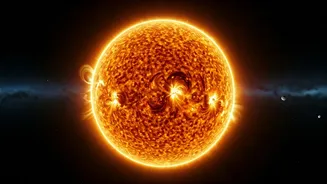
The headline's claim isn't just an exaggeration; it's a fundamental truth of our cosmic neighbourhood. In fact, it’s a slight understatement. Credible scientific sources confirm that our Sun accounts for a staggering 99.86% of the total mass in the entire
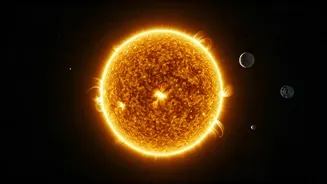
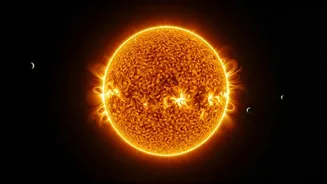
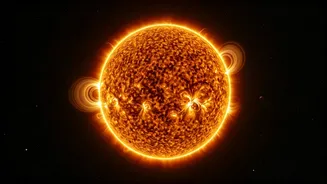
solar system. [1, 2, 3, 5, 9] This means that every planet, moon, asteroid, and comet combined makes up a mere 0.14% of the system's mass. [1, 5] To put that into perspective, the Sun is more than 700 times more massive than everything else put together. [1] It’s a level of dominance that is difficult to comprehend. The Sun’s mass is about 330,000 times that of Earth, and you could fit approximately 1.3 million Earths inside it by volume. [3, 17]
King Jupiter and the Leftovers
So, what about the planets we know and love? Of the tiny 0.14% of mass that isn't the Sun, one planet reigns supreme: Jupiter. [1] The gas giant is so enormous that it contains nearly two and a half times the mass of all the other planets combined. [18] In the grand scheme of the solar system's mass budget, Jupiter alone accounts for about 0.10%. [1, 2] This means that the remaining seven planets—including Saturn, Uranus, Neptune, and our own Earth—plus all the moons and asteroids, are squabbling over the final 0.04% of the system’s total mass. [1] Saturn, the second-largest planet, takes most of that. The four rocky inner planets, Mercury, Venus, Earth, and Mars, are almost a rounding error in this cosmic calculation, comprising a minuscule fraction of the remaining percentage. [12]
Why the Sun Got So Big
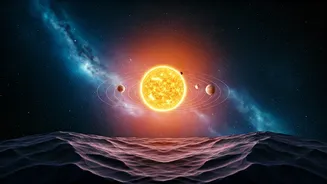
This incredible imbalance isn't an accident; it’s a direct result of how our solar system formed around 4.6 billion years ago. [3, 7] The process began with the gravitational collapse of a giant cloud of gas and dust known as a solar nebula. [7, 13] As this cloud collapsed, conservation of angular momentum caused it to spin faster and flatten into a disk, much like a spinning pizza dough. The vast majority of the material—the gas and dust—was pulled toward the center by gravity. [7, 13] This central clump grew denser and hotter, eventually becoming so compressed that nuclear fusion ignited in its core, and the Sun was born. The planets formed from the leftover material in the swirling disk, accreting from what little matter wasn’t swallowed by the proto-Sun. [6, 7]
Gravity's Unseen Hand
The Sun's immense mass is the very reason we have a solar system at all. Its gravitational pull is the organising force that holds everything together, dictating the orbits of every planet, from Mercury’s swift 88-day journey to Neptune’s distant 165-year trek. [4, 17] This gravity is so powerful that it keeps planets locked in stable, predictable paths, creating the cosmic clockwork we rely on. Jupiter is so massive that the shared centre of gravity between it and the Sun, known as the barycenter, actually lies just outside the Sun's surface. [1] For all other planets, this point is well within the Sun itself. This gravitational dominance provides the stability needed for planets like Earth to exist in a habitable zone, receiving a steady and life-sustaining supply of energy.