

The Sun's Final Act Begins
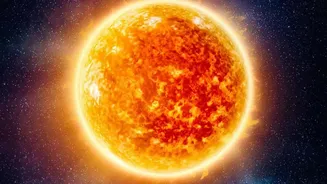
For billions of years, the Sun has been in its stable main sequence phase, fusing hydrogen into helium in its core. This process generates the light and heat that sustains our solar system. But this fuel is finite. In roughly five billion years, the hydrogen in the Sun's
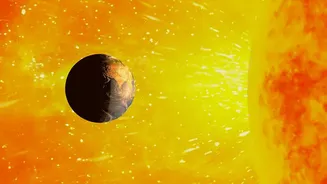
core will run out. Gravity will then overwhelm the outward pressure from fusion, causing the core to contract and heat up. This triggers a new phase of fusion, burning helium into heavier elements like carbon. The energy released will cause the Sun's outer layers to swell dramatically, transforming it into a red giant.
A Red Giant's Fiery Reach
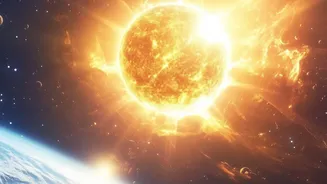
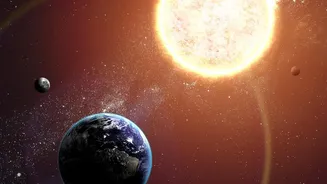
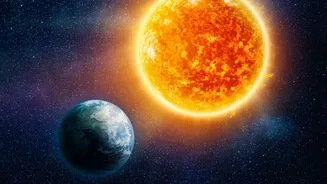
As a red giant, the Sun will expand to over 100 times its current size, becoming thousands of times brighter. Its expanding atmosphere will inevitably swallow the innermost planets, Mercury and Venus. Earth's fate hangs in the balance; some models suggest it will be engulfed, while others propose it might barely escape, only to be scorched into a lifeless rock. The inner solar system, for all intents and purposes, will be destroyed. But for the planets of the outer solar system, this is just the beginning of a new and violent chapter.
A New Reality for the Gas Giants
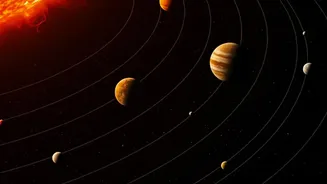
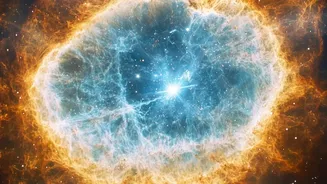
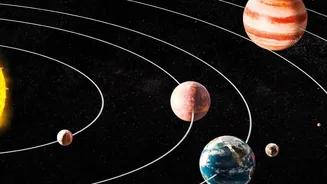
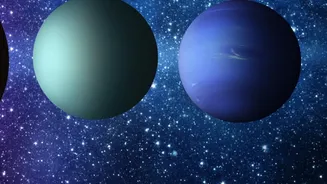
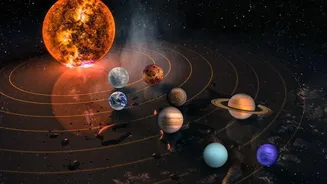
Jupiter, Saturn, Uranus, and Neptune are too far away to be swallowed by the red giant Sun. However, they will not be spared its effects. The intense radiation from the swollen star will heat their atmospheres, potentially stripping away some of their gaseous layers. Their frozen moons, like Europa and Titan, may temporarily develop liquid water oceans on their surfaces before this water is ultimately boiled away. The most significant change comes from the Sun itself. As it ages, it sheds a huge portion of its mass—up to half—into space through powerful stellar winds and the eventual ejection of its outer layers as a planetary nebula.
Gravity's Weakening Grip
With the Sun losing so much mass, its gravitational pull on the remaining planets will weaken significantly. This will cause the orbits of Jupiter, Saturn, Uranus, and Neptune to expand, pushing them farther out into space. For a long time, scientists believed these new, wider orbits would be stable for hundreds of billions of years, perhaps until a passing star disrupted them. However, a very recent study from October 2026 has dramatically changed this timeline. It suggests the Sun's death will be far more chaotic than previously thought.
A Chaotically Unstable Ending
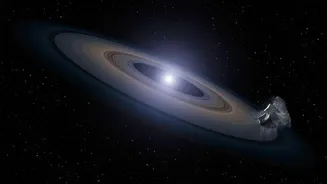
New research published in 'The Astrophysical Journal Letters' argues that the Sun won't lose its mass smoothly. Instead, it will likely happen in lumpy, uneven bursts that will give the dying star little 'kicks'. These kicks will send gravitational shudders through the solar system, destabilizing the carefully balanced orbits of the outer planets. According to simulations run by the study's authors, this chaotic process means the outer solar system could fall apart in as little as one billion years after the Sun becomes a white dwarf—a timeline a billion times shorter than prior estimates. This terminal instability could see planets ejected from the solar system entirely, sent to wander the galaxy as rogue worlds.