




The Universe's Coolest Experiment
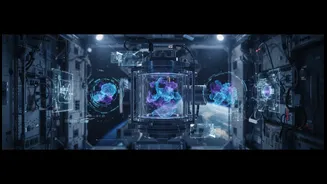
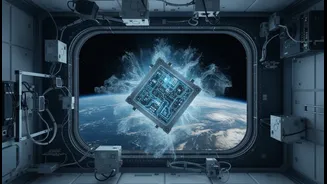
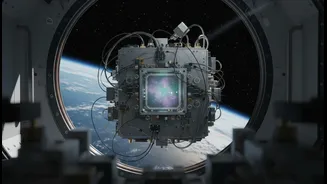
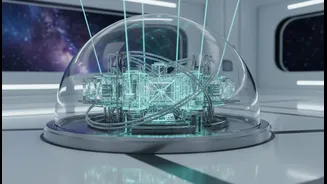
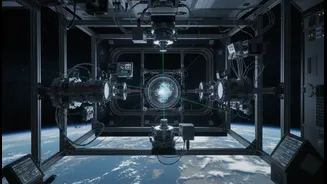
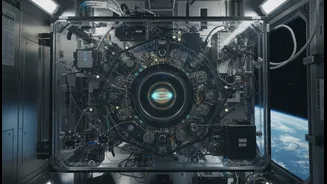
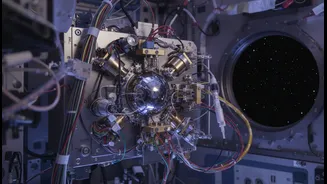
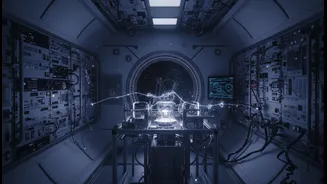
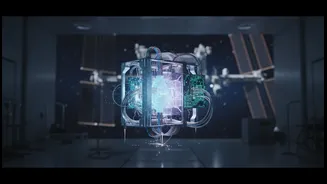
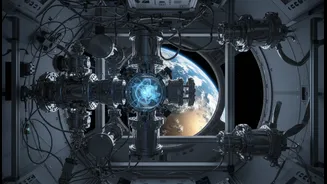
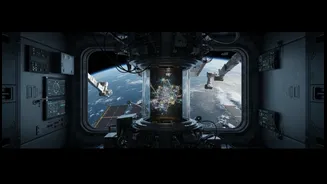
Inside a facility on the International Space Station (ISS) called the Cold Atom Lab, scientists are doing something extraordinary: they are chilling atoms to temperatures just a fraction above absolute zero, or minus 273.15 degrees Celsius. This is colder
than any naturally occurring temperature in the universe. To do this, they use lasers to slow down atoms of elements like rubidium, effectively chilling them. Then, magnetic fields trap these super-slow atoms. At these extreme temperatures, atoms stop behaving like individual particles and enter a bizarre fifth state of matter, predicted by Satyendra Nath Bose and Albert Einstein in the 1920s, called a Bose-Einstein Condensate (BEC). In a BEC, the thousands of individual atoms act like one single, massive quantum wave, making their strange quantum properties much easier to study.
Why Space is the Ultimate Laboratory
While scientists can create BECs in labs on Earth, gravity gets in the way. The constant pull of our planet causes these delicate quantum clouds to collapse quickly, limiting observation time. In the microgravity environment of the ISS, these effects are almost non-existent. This allows researchers to create larger BECs that last for much longer—several seconds instead of milliseconds. This extended time is crucial, giving scientists a clearer and longer window to observe how these condensates behave and interact with forces like gravity. Since its installation in 2018, the Cold Atom Lab has been continuously upgraded, allowing for even more precise control over these quantum states, essentially creating a unique and powerful laboratory for fundamental physics.
Enter the Quantum Sensor
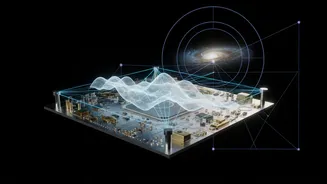
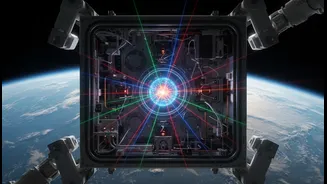
So, what does this have to do with sensors? Quantum sensors are a new class of devices that use the principles of quantum mechanics—like the weird wave-particle nature of atoms—to make incredibly precise measurements. They can detect minuscule changes in gravity, magnetic fields, rotation, and time, far beyond the capability of classical sensors. One of the most promising types is the atom interferometer. It works by splitting a cloud of cold atoms, letting the two halves travel along different paths, and then recombining them. Any tiny difference in their environment, like a slight change in gravity, will alter the wave patterns when they merge, which can be measured with extreme accuracy.
Connecting Cold Atoms to Better Sensors
This is where the ISS research becomes critical. A Bose-Einstein Condensate is the perfect starting material for an atom interferometer because it's a coherent, unified quantum object. By studying how BECs behave in the pristine environment of space, scientists can perfect the techniques needed to build more robust and sensitive quantum sensors on Earth. The research on the Cold Atom Lab is essentially a blueprint, helping scientists understand how to best manipulate these matter waves. This knowledge directly informs the design of next-generation sensors for navigation, geology, and more. The work has already demonstrated that the complex equipment needed for these experiments can operate reliably in space, a key step toward future applications.
A Quantum Leap for Technology in India
The development of advanced quantum sensors holds immense promise for India. One of the most critical applications is in navigation. With rising instances of GPS signals being jammed or spoofed, the ability to navigate without relying on satellites is a major strategic priority for defence and aviation. Quantum sensors can provide this capability, enabling submarines, aircraft, and drones to navigate with precision using only tiny variations in Earth's gravitational field. Beyond defence, these sensors could be game-changers for resource exploration, helping to map underground aquifers or locate mineral deposits with unprecedented accuracy. In healthcare, they could lead to more sensitive medical imaging devices. India's National Quantum Mission has identified quantum sensing as a key priority, aiming to achieve technological self-reliance and become a global leader in this transformative field.