



A Steamy Welcome to GJ 9827 d
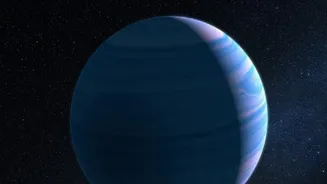
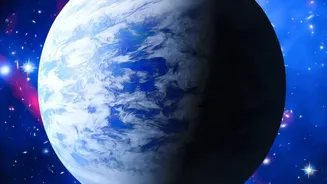
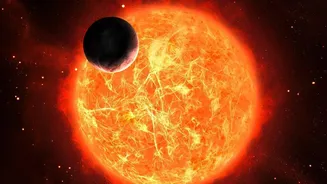
The planet at the centre of this exciting discovery is named GJ 9827 d. Located approximately 97 light-years from Earth in the constellation Pisces, it is what astronomers call a 'super-Earth'—about twice the diameter of our own planet. While Hubble had
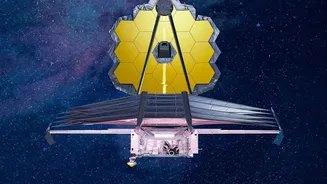
previously found tantalising hints of water here, the power of the JWST has provided a much clearer picture, confirming a water-rich atmosphere. This makes GJ 9827 d the smallest exoplanet to date with such a confirmed atmospheric detection. For scientists, this is a monumental achievement. Detecting the whisper-thin veil of an atmosphere around a relatively small, rocky planet so far away is a testament to the incredible sensitivity of the James Webb telescope's instruments.
How Webb Reads Alien Air
So, how exactly does a telescope see water vapour nearly 100 light-years away? The technique is called transmission spectroscopy. Scientists wait for the planet to pass in front of its host star from our point of view, an event known as a transit. As the star's light filters through the planet's atmosphere, some of it is absorbed by the molecules present in that atmosphere. Every gas—water vapour, methane, carbon dioxide—absorbs light at very specific wavelengths, creating a unique chemical 'barcode'. The James Webb telescope's Near-Infrared Spectrograph (NIRSpec) is exquisitely designed to capture this light and spread it out into a spectrum, allowing astronomers to read this barcode and identify the chemical composition of the alien air. It's a method that turns a distant star's momentary dimming into a profound data-gathering opportunity.
Not Earth 2.0, But a 'Steam World'
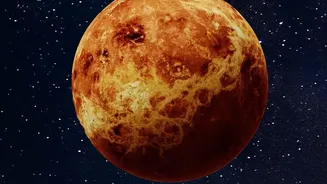
While the presence of water always sparks excitement, it's important to understand the environment of GJ 9827 d. This is no lush, Earth-like paradise. The planet orbits its star very closely, completing a full year in just 6.2 days. This proximity results in scorching surface temperatures. Instead of liquid oceans and fluffy white clouds, GJ 9827 d is believed to be a 'steam world.' Its atmosphere is almost entirely composed of superheated water vapour, creating a dense, crushing environment unlike anything in our solar system. This finding has led scientists to two main theories about its origin: either it is a 'mini-Neptune' that has lost its massive hydrogen atmosphere, leaving behind a water-heavy core, or it formed further from its star where water ice was plentiful and later migrated inward.
The Challenge of Certainty
Even with Webb's power, cosmic detective work is complex. In another recent investigation of a rocky exoplanet, GJ 486 b, scientists also found signs of water. However, they were careful to note that the signal could be coming not from the planet's atmosphere, but from cool, watery starspots on the surface of its host star. Red dwarf stars, which these planets often orbit, are cooler than our sun, allowing water vapour to exist in their starspots. Disentangling a planetary signal from a stellar one is a major challenge that astronomers are actively working on. However, for GJ 9827 d, multiple observations have strengthened the conclusion that the water is indeed part of the planet's own atmosphere, making it a benchmark discovery.
A Stepping Stone to Habitable Worlds
Ultimately, the discovery of a steam-filled atmosphere on GJ 9827 d is less about finding life and more about proving our capability to even ask the right questions. It confirms that rocky planets can retain significant, water-rich atmospheres and, crucially, that we now have the technology to detect them. This is a foundational step. Each such discovery sharpens our techniques and brings us closer to the ultimate goal: analysing the atmospheres of Earth-sized planets located in the 'habitable zone' of their stars—the orbital sweet spot where temperatures could allow for liquid water. This finding is a powerful demonstration that we are entering a new era of exoplanet exploration, moving from simply counting planets to truly characterising them.