





A Planet That Shouldn't Exist
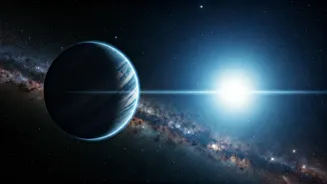
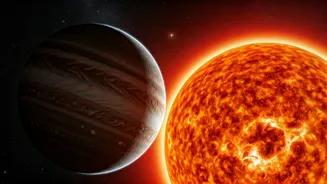
Meet WD 1856 b, a planet that poses a fascinating cosmic puzzle. Located about 80 light-years from Earth, it's a world roughly the size of Jupiter. The strange part isn't its size, but its location. It orbits a white dwarf—the tiny, super-dense remnant
of a star that was once like our Sun. The planet circles this stellar corpse every 34 hours, at a distance 50 times closer than Earth is to the Sun. According to everything we know about stars, this planet should have been obliterated. When its star reached the end of its life, it would have swelled into a massive red giant, engulfing and destroying anything in such a close orbit. Yet, somehow, WD 1856 b survived. This discovery, published in July 2026, has provided astronomers with a unique laboratory to study planetary survival.
Webb Detects a Ghostly Atmosphere
To solve this mystery, astronomers pointed the James Webb Space Telescope at the system. Using a technique called transmission spectroscopy, Webb watched as the planet passed in front of its tiny star. The starlight filtering through the planet’s atmosphere left behind telltale chemical fingerprints. For the first time ever on a planet orbiting a dead star, Webb detected an atmosphere. The data revealed the presence of hydrocarbons, most likely methane, as well as evidence of small cloud particles. This finding alone is a landmark achievement. It proves that even after the violent death of a star, a nearby planet can retain or regenerate an atmosphere, opening a new chapter in our understanding of planetary resilience.
An Unexpected Temperature Puzzle
The discoveries didn't stop there. Webb's sensitive instruments also measured the heat radiating directly from the planet itself. The telescope found that WD 1856 b has a temperature of about 126 degrees Celsius. While certainly not comfortable, this is significantly hotter than it should be if it were only being warmed by the faint light of its white dwarf star. This puzzling heat turned out to be the crucial clue. Scientists realized there was no current energy source that could account for this high temperature. It had to be leftover, or residual, heat from something that happened in the planet's past. The mystery of the planet's survival was suddenly linked to the mystery of its unusual warmth.
Solving a Cosmic Cold Case
By combining the planet's mass, its current temperature, and models of how giant planets cool over time, the science team was able to work backward. The excess heat indicated that the planet must have been intensely heated at some point and is now slowly cooling down. This supports a dramatic theory for its survival: WD 1856 b wasn't always this close to its star. It likely started its life much farther out, safely beyond the reach of the star's red giant phase. After the star collapsed into a white dwarf, complex gravitational interactions, possibly from two other stars in the same system, nudged the planet inward on a new, much tighter orbit. The planet didn't just survive its star's death; it undertook an incredible migration across its solar system afterward. Webb's ability to detect its faint atmospheric glow and residual heat was the key to unlocking this incredible story.