

A Million-Degree Mystery
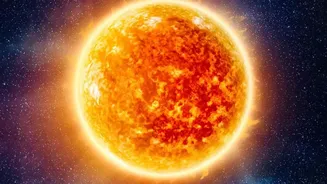
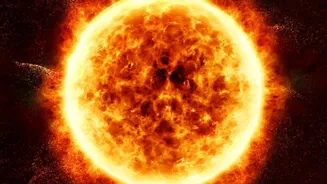
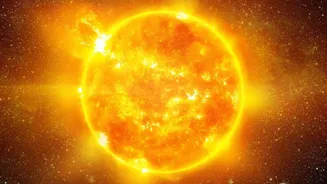
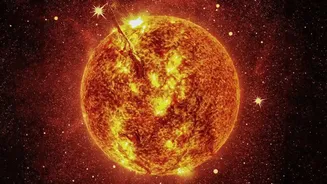
Imagine standing by a fire and feeling colder as you step closer. It sounds impossible, but something similar happens on the Sun. The visible surface, or photosphere, clocks in at a blistering 5,500 degrees Celsius. Logic dictates that the further you move
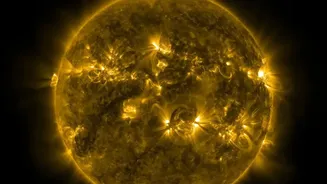
from this heat source, the cooler it should get. Yet, the Sun's outer atmosphere, the corona, sizzles at an astonishing one to two million degrees, and sometimes even hotter. This puzzle, known as the coronal heating problem, has baffled solar physicists for nearly a century. Scientists have long theorized that the answer lies in the complex transfer of energy through the Sun's powerful magnetic fields, but the exact mechanism has remained stubbornly out of sight.
The Search for an Answer
For decades, one of the leading theories proposed that waves of plasma could be carrying energy from the Sun's churning interior and depositing it in the corona, superheating it like a constant whip-crack of energy. These are known as Alfvén waves, magnetic disturbances predicted in 1942 that can carry incredible amounts of energy through plasma without compressing it. Scientists have spotted larger versions of these waves before, usually linked to dramatic events like solar flares. However, finding the persistent, smaller-scale waves that could be responsible for the constant high temperatures of the corona has been a long and difficult search. The challenge is like trying to hear a specific whisper in the middle of a roaring stadium; the evidence was there in theory, but observing it directly was beyond the reach of previous instruments.
A Wave of Discovery
Now, thanks to the world's most powerful solar telescope, the Daniel K. Inouye Solar Telescope in Hawaii, scientists have finally had a breakthrough. Recent observations have provided the first direct evidence of small-scale, twisting plasma motions, known as torsional Alfvén waves, rippling through the corona. These elusive waves, which twist back and forth like a wringing towel, had been hypothesized for over 80 years but never directly seen. The Inouye telescope, with its unprecedented resolution, was able to detect the subtle Doppler shifts in light—tiny changes caused by motion—that revealed the twisting dance of superheated plasma, confirming the waves' existence. This discovery is not just a fleeting glimpse; it reveals a constant, underlying process at work on the Sun.
A New Way to See the Corona
This discovery does more than just confirm a long-held theory; it provides a brand new tool for studying our star. The concept is called solar seismology, which is similar to how geologists use earthquake waves to understand Earth's interior. By tracking how these plasma waves propagate, twist, and travel through the corona, scientists can essentially perform a remote scan of the solar atmosphere. The speed and shape of the waves are influenced by the temperature, density, and magnetic field of the plasma they move through. By observing the waves, researchers can work backward to map these properties of the corona in incredible detail, giving them a new "view" into a region that is otherwise incredibly difficult to measure directly. This allows them to build a more complete picture of how energy flows and dissipates throughout the Sun's atmosphere.
Why This Matters for Us on Earth
Unlocking the secrets of the corona isn't just an academic exercise. This superheated region is the source of the solar wind, a constant stream of charged particles that flows out to fill the entire solar system. It's also where massive eruptions, like solar flares and coronal mass ejections (CMEs), originate. These events create what is known as space weather, which can have significant impacts here on Earth. Powerful solar storms can disrupt our satellite communications, damage power grids, and even pose a risk to astronauts in space. A better understanding of the fundamental physics heating the corona will lead to better models for predicting space weather. By knowing what powers these solar events at their source, we can improve our ability to forecast their arrival and intensity, giving us more time to protect our crucial technological infrastructure.