





Artemis: Gearing Up for the Next Leap to the Moon
Progress on NASA's Artemis program, which aims to establish a sustainable human presence on the Moon, is accelerating. The successful uncrewed Artemis I flight in 2022 and the crewed Artemis II lunar fly-by in April 2026 set the stage for the next critical
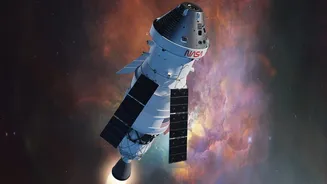
phases. Currently, all eyes are on Artemis III, a demonstration mission planned for 2027 that will test the crucial rendezvous and docking capabilities between the Orion spacecraft and new commercial human landing systems in low Earth orbit. NASA Administrator Jared Isaacman has expressed extreme confidence that this mission will launch next year. Hardware for the powerful Space Launch System (SLS) rocket is already being assembled at Kennedy Space Center, with teams joining the Orion crew and service modules in late July 2026. This mission is a vital dress rehearsal for Artemis IV, which is targeted for 2028 and slated to be the first crewed lunar landing of the program.
Mars Sample Return: A Mission in Transition
The ambitious goal of bringing the first pristine samples of Martian rock and soil to Earth is undergoing a major strategic overhaul. The Mars Sample Return (MSR) mission, a joint effort with the European Space Agency, has faced significant budget and schedule challenges. In response, NASA is re-evaluating its approach. The original plan has been scrapped, but the mission is far from dead. The agency is now actively considering two primary options for landing the retrieval hardware on Mars and is expected to make a final decision on the new mission design in the latter half of 2026. While this means the samples, which were collected by the Perseverance rover and are waiting safely on the Martian surface, won't be back on Earth until at least 2035, NASA remains committed to what would be a landmark achievement in planetary science.
JWST: Unveiling the Early Universe's Secrets
The James Webb Space Telescope (JWST) continues to revolutionize our understanding of the cosmos. In August 2026, astronomers reported several groundbreaking findings. One major discovery is that the universe's first galaxies may be much more massive than previously believed. By peering into the faint light between the brightest, most obvious stars, JWST has uncovered vast populations of smaller, dimmer stars, suggesting these early galactic structures were more substantial than they appeared. In other recent news, the telescope has potentially solved the mystery of cosmic "little red dots"—compact, distant objects seen in the early universe. Analysis suggests these may be a temporary phase in the life of highly active supermassive black holes. Another team using JWST data announced the discovery of a new type of object entirely: a "black hole star," a solar-system-sized body that glows like a star but is powered by a feeding black hole at its core.
Future Frontiers: Dragonfly and Europa Clipper
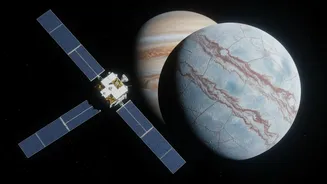
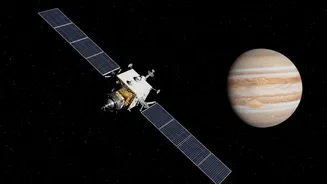
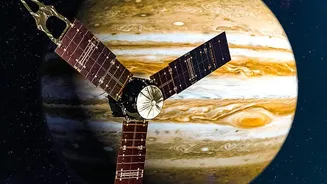
Looking further ahead, NASA is making steady progress on two of its most exciting future missions. The Europa Clipper, which launched in October 2024, is currently en route to Jupiter's icy moon, Europa. The spacecraft is on track for a planned Earth gravity assist in December 2026, a critical maneuver that will sling it toward its 2030 arrival in the Jovian system, where it will investigate Europa's hidden ocean and assess its potential for life. Meanwhile, the Dragonfly mission, a nuclear-powered, car-sized rotorcraft, is preparing for its own journey. It remains on schedule for a July 2028 launch aboard a SpaceX Falcon Heavy rocket. After a six-and-a-half-year cruise, Dragonfly will arrive at Saturn's largest moon, Titan, in late 2034. There, it will fly through Titan's dense atmosphere to explore its surface, studying the complex organic chemistry that could provide clues about the building blocks of life.