

More Than Just Stars in the Sky
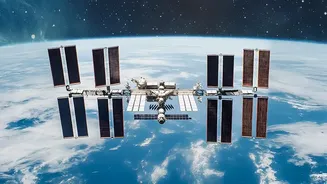
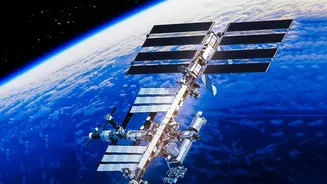
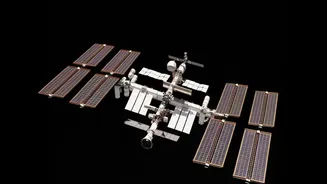
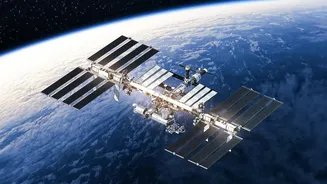
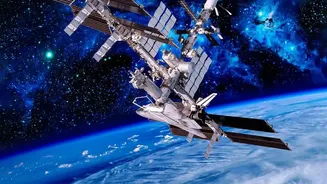
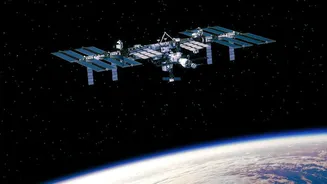
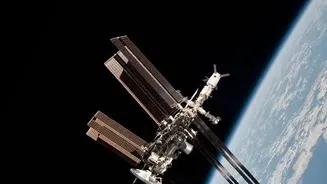
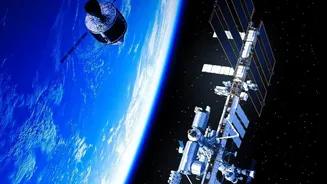
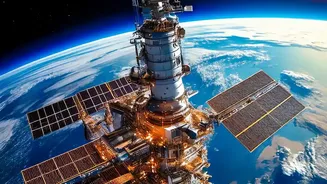
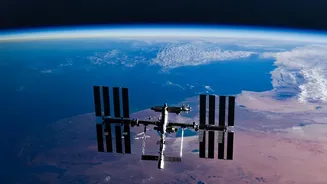
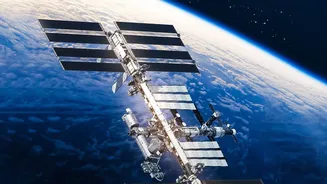
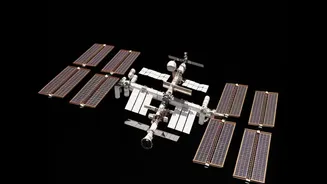
Since 1957, thousands of objects have been launched into orbit around Earth. Most are too small or too faint to see, but some, like the International Space Station (ISS), are surprisingly easy to spot. The ISS is the largest object in orbit, roughly the size
of a football field, including its massive solar arrays. It doesn't have its own lights visible from the ground; what you see is sunlight reflecting off its surface. This is why the best times to spot satellites are in the hours just after sunset or before sunrise. During these periods, you're in darkness on the ground, but the satellite, being hundreds of kilometres up, is still bathed in sunlight, making it stand out against the twilight sky. A typical pass can last for several minutes as the object moves steadily from one horizon to the other. Unlike an airplane, it won't have flashing lights.
Your Smartphone as a Personal Planetarium
Just a decade ago, tracking satellites required consulting complex charts or websites. Today, your phone can do all the work. Modern stargazing applications use your device's GPS and compass to know your exact location and where you're pointing it. They can then overlay a detailed map of the stars, planets, and satellites in real time. This augmented reality (AR) view transforms stargazing from a guessing game into an interactive tour of the cosmos. For satellite spotting, these apps provide precise predictions, sending alerts to your phone so you never miss a bright pass over your specific location.
Top Free Apps for Satellite Spotting
While many excellent stargazing apps exist, several are particularly good for tracking satellites for free. NASA App & Spot The Station: NASA's official app is a must-have for space enthusiasts, offering news, images, and a reliable ISS tracker. For a more focused experience, NASA's Spot The Station app is dedicated solely to providing alerts and viewing opportunities for the space station. It offers an easy-to-use AR interface to help you find the station in the sky. Stellarium Mobile: A powerful and popular planetarium app, Stellarium's free version includes the ability to identify and track satellites, including the ISS. Its detailed star maps help you understand exactly where the satellite will be passing in relation to known constellations. Heavens-Above: This is a classic and highly respected tool for satellite predictions. The free app provides 10-day predictions for the ISS and other visible satellites, generating the forecasts right on your phone. It provides detailed information on brightness, altitude, and the path the satellite will take across your sky. ISS Detector: As the name implies, this app is specifically tailored for watching the ISS and other satellites. The free version is easy to interpret and provides notifications for upcoming passes, along with weather conditions and brightness predictions.
Planning Your First Sighting
Once you've downloaded an app, the process is straightforward. First, ensure your location services are enabled so the app knows where you are. Look for a section on satellites or specifically for the ISS. The app will present a list of upcoming visible passes for the next several days. Each pass will have key information: the time it starts, its duration, its maximum height (or altitude), and the direction it will appear and disappear. The height is measured in degrees, with 0 degrees being the horizon and 90 degrees being directly overhead. Higher passes are generally brighter and easier to see. Many apps also give a brightness value (magnitude); a lower number means a brighter object. Set a notification for a promising pass—ideally one that is long, high, and bright.
Tips for the Best Viewing Experience
To make the most of a satellite pass, find a viewing spot with a clear, unobstructed view of the sky, away from the glare of city lights if possible. Give your eyes at least 15-20 minutes to adjust to the darkness; this will help you spot fainter objects. When the time comes, use the app's compass or AR view to know which direction to face. Remember what you're looking for: a steady, bright point of light moving silently and purposefully across the sky. It can appear as bright as the planet Venus and is an unforgettable sight.